
Leadership and Innovation
Degrees

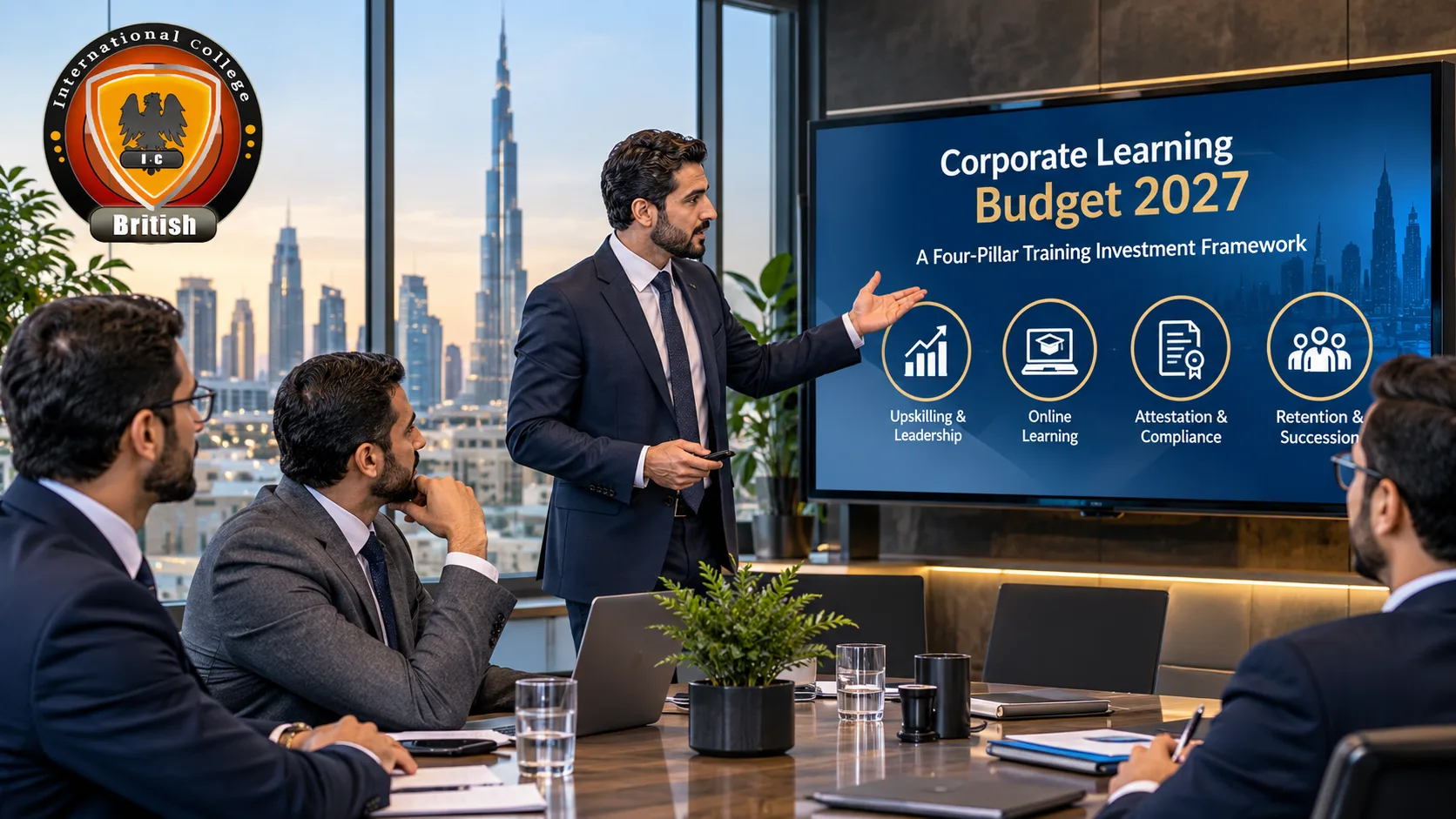
Building a high-ROI corporate learning budget 2027 requires Gulf HR directors to shift capital away from one-off, travel-heavy workshops toward structured, outcome-tied online postgraduate and executive pathways. An effective training investment framework allocates funds across four operational lines—core technical upskilling, leadership succession, cross-border document attestation, and retention-linked governance—allowing enterprises to scale capability across GCC offices with zero employee downtime.
Across Saudi Arabia, the UAE, Qatar, Kuwait, Bahrain, and Oman, corporate training budgets frequently suffer from fragmented, reactive spending. Department heads approve isolated short courses late in the fiscal year to exhaust remaining funds, resulting in high per-employee expenditure and minimal operational transfer.
For HR directors preparing L&D budget planning GCC proposals for CFO sign-off, three structural flaws undermine traditional training allocations:
High Indirect Overhead: Off-site regional seminars consume substantial budget through flights, hotels, and per-diem allowances before a single hour of instruction occurs.
Operational Disruption: Removing mid-level managers and technical specialists from active projects for multi-day workshops creates immediate productivity bottlenecks across lean teams.
Unverified Skill Progression: Attendance certificates from unassessed short workshops provide finance committees with no objective metric of capability growth or readiness for promotion.
Transitioning to accredited-pathway distance learning resolves these inefficiencies. Working professionals complete rigorous academic and executive coursework asynchronously alongside a full-time schedule, converting static training spend into measurable organizational capability.
To secure executive approval, a corporate learning budget 2027 must operate as a capital allocation model rather than an administrative expense line. Structuring the budget around four distinct pillars ensures every dirham or riyal maps directly to workforce retention, nationalisation targets, and leadership continuity.
Separating operational training from long-term succession prevents high-potential leadership investments from being cannibalised by routine compliance spending.
Operational Capability Pool: Dedicated to immediate role proficiency—such as project management methodologies, financial modelling, contract compliance, and applied AI literacy for non-technical managers.
Leadership Succession Pool: Reserved for high-performing supervisors and department heads transitioning into senior management through structured postgraduate diplomas or master's-level programmes.
Strategic Reserve: A ring-fenced allocation held for urgent regulatory shifts, digital transformation rollouts, or newly identified internal promotion tracks.
Finance committees scrutinise cost-per-learner alongside business continuity. Comparing traditional in-person corporate training against structured distance learning clarifies why online executive education dominates modern employee upskilling programme design.
|
Budget & Operational Factor |
Traditional In-Person Seminars |
Structured Online / Distance Programmes |
|
Direct Tuition Allocation |
High per-day trainer and venue fees |
Predictable per-seat modular or programme tuition |
|
Travel & Logistics Overhead |
Flights, hotels, and regional transport costs |
Zero travel or physical venue expenditure |
|
Workforce Downtime |
Full absence during multi-day workshops |
Zero operational absence via asynchronous study |
|
Multi-Branch GCC Scalability |
Restricted by city location and seat caps |
Uniform rollout across KSA, UAE, and regional hubs |
|
Assessment & Rigour |
Completion based on physical attendance |
Graded coursework, applied projects, and formal exams |
In Gulf jurisdictions, formal qualifications frequently require official authentication for internal grading, public-sector tendering, or regulatory compliance. When budgeting for sponsored postgraduate diplomas or degrees, HR directors should account for administrative verification workflows alongside tuition:
Notarisation and Apostille Fees: Costs associated with certifying academic transcripts and award certificates in the country of issuance.
Ministry of Foreign Affairs (MOFA) and Embassy Legalisation: Processing fees and courier logistics required to legalise documents for use in Saudi Arabia, the UAE, or other GCC states.
Equivalence Application Processing: Administrative fees tied to formal credential evaluation where required by sector regulators or semi-government employers.
A training investment framework protects enterprise capital only when paired with clear sponsorship governance. When the employer signs the tuition invoice, HR and Legal must establish transparent mutual obligations before enrollment begins.
Effective corporate sponsorship policies in the Gulf rely on four standard controls:
Line-Manager Business Case: Applicants submit a brief operational justification linking their chosen programme modules to a specific departmental KPI or upcoming project.
Academic Progress Gates: Tuition disbursements are structured across academic terms or modules rather than paid unconditionally upfront, requiring verified submission of coursework to unlock subsequent tranches.
Service Commitment Agreements: A pro-rated retention clause—typically spanning 12 to 24 months post-completion—requiring partial tuition repayment if the employee voluntarily resigns before the commitment period concludes.
Internal Knowledge Transfer: Sponsored employees deliver an internal briefing or apply their capstone project directly to an active company workflow.
Linking finance releases to verified academic and workplace milestones gives CFOs real-time visibility into training ROI.
|
Governance Stage |
Verification Trigger |
HR & Finance Control Action |
|
Stage 1: Admission & Onboarding |
Formal offer letter and signed sponsorship agreement |
Release initial enrollment tranche; log retention clause in HRIS |
|
Stage 2: Mid-Programme Review |
Transcript confirmation of passed core modules |
Approve second-term payment; conduct manager alignment check |
|
Stage 3: Applied Capstone |
Submission of work-based dissertation or final project |
Review operational recommendations with department head |
|
Stage 4: Post-Completion |
Final award conferral and legalised documentation |
Update employee competency matrix and succession eligibility |
HR directors targeting a January 2027 cohort launch must complete internal budget alignment during Q4. Following a disciplined sequence ensures nominations, financial approvals, and admissions documentation conclude before year-end fiscal freezes:
Conduct a Department-Level Skills Audit: Map current managerial gaps across project delivery, finance, legal compliance, and digital leadership against 2027 operational targets.
Segment Nominees by Track: Separate staff suited for focused postgraduate diplomas from senior candidates ready for full master's-level leadership study.
Establish Corporate Cohort Pricing: Consolidate individual departmental requests into a single institutional procurement brief to secure multi-seat corporate billing terms and structured payment schedules.
Finalise Sponsorship Policy Addenda: Align Legal and Finance on milestone-based invoicing and pro-rated retention agreements prior to issuing internal nominations.
Submit Applications Ahead of Intake Deadlines: Collect academic transcripts, identification documents, and corporate sponsorship letters early to ensure seamless onboarding for the January 2027 academic start.
Equip your high-potential managers and technical specialists with flexible, career-aligned online postgraduate qualifications without disrupting daily operations across your Gulf offices. Contact International College’s Corporate Partnerships team today to request a tailored 2027 B2B fee schedule, multi-seat cohort proposal, and programme syllabus alignment for your L&D budget submission.
International College of Economics and Political Science (ICEPS) is an online education provider focused on professional learning, executive development, and career advancement. Our programmes are delivered online.

internationalcollege-online