
Leadership and Innovation
Degrees

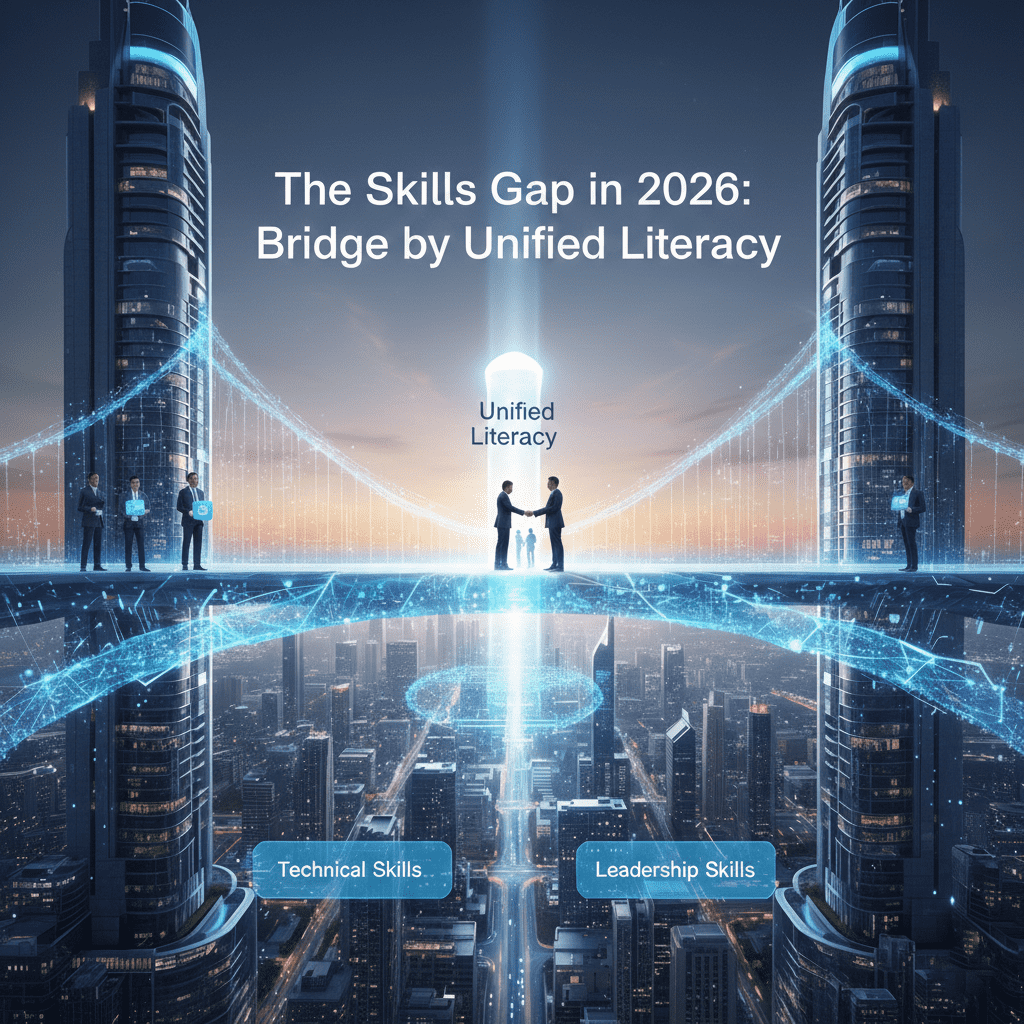
The skyline of Dubai is no longer the only thing reaching new heights; the expectations of its employers are skyrocketing. As we move through 2026, the UAE job market is experiencing a profound shift driven by the Dubai Economic Agenda (D33) and the rapid integration of autonomous technologies.
The result? A significant skills gap in the UAE for 2026. Traditional qualifications that once secured a comfortable middle-management role are no longer enough. Today, the "Trust Gap" is real—employers are scrutinizing not just what you know, but the authority and verifiability of where you learned it.
For years, the debate centered on whether technical prowess or leadership capability was more important. In 2026, the answer is "Unified Literacy."
While technical skills—particularly in AI, sustainability, and data analytics—are the entry requirement, they have become commoditized. The real skills gap in the UAE for 2026 lies in the human element. Employers in Dubai are shifting their focus toward leaders who can bridge the gap between complex technical systems and strategic business outcomes.
Based on current market trajectories and regional economic goals, these are the top 10 skills for 2026 that determine hiring success in the UAE:
AI Orchestration: Not just using AI, but managing AI-driven workflows and teams.
Strategic Adaptive Leadership: The ability to pivot organizational strategy in real-time response to global market shifts.
Data Ethics & Governance: Ensuring organizational data usage aligns with strict UAE regulatory frameworks.
Sustainability Management (ESG): Aligning business operations with the UAE’s "Net Zero by 2050" initiative.
Cross-Cultural Intelligence: Leading increasingly diverse, globalized teams within the Dubai hub.
Complex Problem Solving: Navigating the "polycrisis" environment of the modern economy.
Emotional Intelligence (EQ): Maintaining team cohesion in high-pressure, high-speed environments.
Digital Project Management: Mastering the tools of the 2026 workspace to deliver on-time ROI.
Financial Acumen: Understanding the macro-economic drivers of the GCC.
Evidence-Based Decision Making: Moving away from "gut feeling" toward data-backed strategy.
In an era of automation, soft skills for managers have become the "hardest" skills to master. Dubai’s top-tier employers are no longer hiring for "management"—they are hiring for "influence."
Managers who cannot communicate vision, resolve conflict, or foster innovation are being replaced by those who can. This shift toward "Human-Centric Leadership" is a core pillar of the International College curriculum, ensuring our graduates don't just manage processes, but inspire people.
The UAE is one of the most competitive labor markets in the world. Consequently, HR departments in 2026 have become hyper-vigilant about "credential inflation."
To bridge the skills gap in the UAE for 2026, you need more than just knowledge—you need a credential that commands absolute trust. At International College, we resolve this through a three-tier verification guarantee:
Ofqual Regulated: All programs are governed by the UK’s official regulatory body, ensuring international academic parity.
UK Embassy Attestation: We facilitate the formal verification process, ensuring your degree is recognized by the British Embassy—a prerequisite for MOFA recognition in the UAE.
WES Recognition: Our degrees are recognized by World Education Services, making them valid for global migration and high-level corporate equivalency.
The skills gap in the UAE for 2026 represents both a threat and an opportunity. For the unprepared, it is a barrier. For the strategic professional, it is the ultimate leverage point.
Employers in Dubai are looking for leaders who have invested in themselves through verified, high-authority education. By aligning your career with a UK-accredited degree that solves the "Trust Gap," you aren't just applying for the future—you are owning it.
International College of Economics and Political Science (ICEPS) is an online education provider focused on professional learning, executive development, and career advancement. Our programmes are delivered online.

internationalcollege-online