
Leadership and Innovation
Degrees

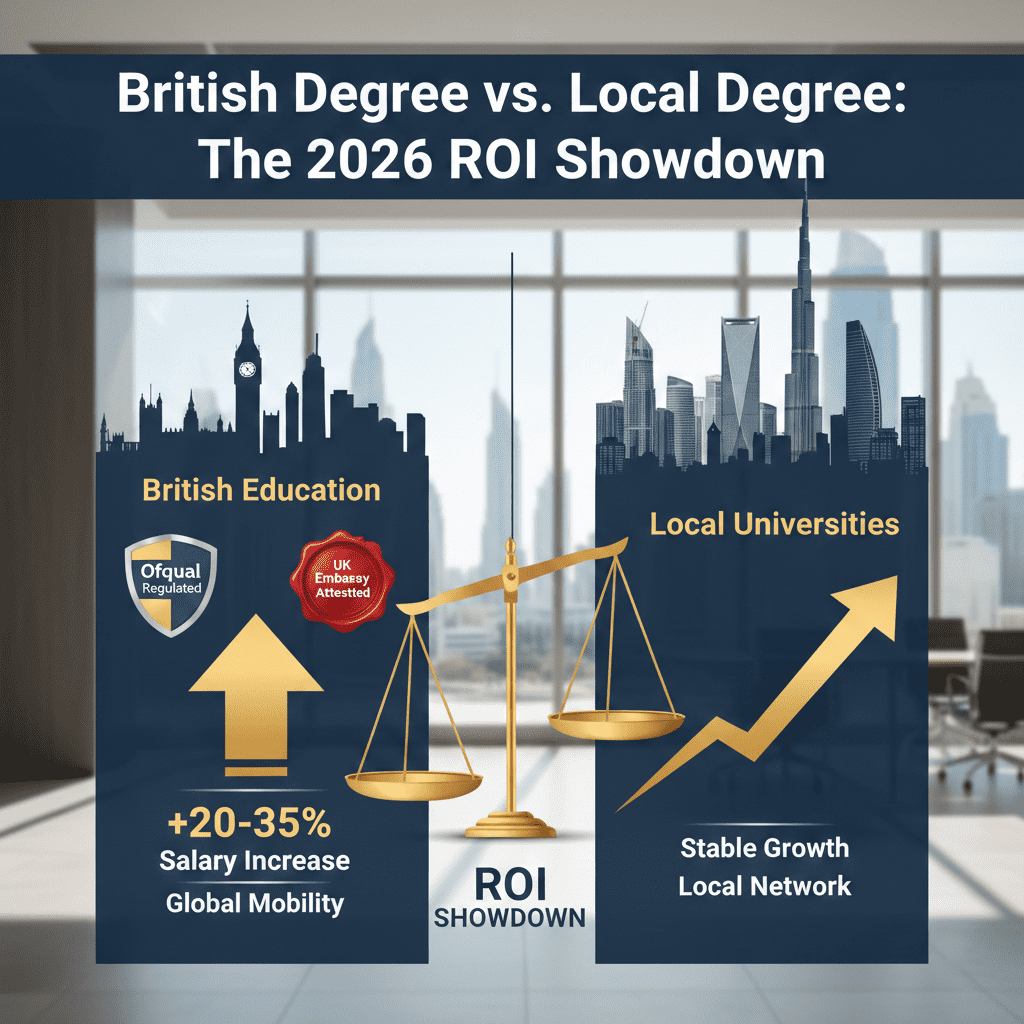
In the rapidly evolving job markets of Riyadh, Dubai, and Abu Dhabi, professionals face a critical crossroads: Should you invest in a local degree or pursue a British qualification?
With Saudi Vision 2030 and Dubai Economic Agenda (D33) demanding high-level leadership skills, the "Return on Investment" (ROI) of your education is no longer just about the tuition fees—it’s about global mobility, salary benchmarks, and long-term career security.
This guide breaks down the data to help you decide which path yields the highest dividends for your career.
While local universities in the Middle East have made significant strides, a British degree remains the "Gold Standard" in global education.
Local Degrees: Often tailored to domestic market needs. While excellent for public sector roles within the same country, they may require extensive "equivalency" processes if you decide to move internationally.
British Degrees: Regulated by Ofqual (The Office of Qualifications and Examinations Regulation), these degrees are globally portable. For a professional in the UAE or KSA, a UK qualification acts as a global passport. Whether you are applying for a role in London, Singapore, or New York, the brand "UK Education" is instantly recognized and trusted.
The biggest fear for professionals in the Middle East regarding international education is the "Trust Gap." Will the degree be recognized by local authorities?
When choosing a British provider like International College, the ROI is protected by three layers of verification:
Ofqual Regulation: Ensures the qualification meets strict UK government standards.
UK Embassy Attestation: Formal legal recognition that the certificate is genuine.
MOFA & WES Recognition: Essential for visa upgrades in KSA/UAE and for those planning to emigrate to Canada or the US (World Education Services recognition).
Local degrees offer a "safe" route, but they lack the international "clout" provided by a verified British credential.
In the Middle East, HR departments often use "Education Tiers" to determine salary brackets.
The Premium: Data suggests that professionals with Western-accredited degrees (specifically from the UK) can command salaries 20% to 35% higher than those with only local qualifications in the private sector.
Promotion Speed: In multinational corporations (MNCs) operating in the GCC, a UK Master’s or MBA is often a prerequisite for "C-Suite" or Director-level promotions.
ROI Fact: While the initial investment in a British degree might be higher, the "Payback Period" (the time it takes to earn back your tuition through salary increases) is significantly shorter compared to local alternatives.
Your "Net Worth" is your "Network."
Local Universities: Provide a strong circle of local contacts. This is beneficial if your entire career trajectory is limited to one specific city or industry.
British Education: Offers access to a global alumni network. Studying for a UK degree—even via high-end distance learning—connects you with professionals across Europe, Asia, and Africa. For someone in Dubai or Riyadh, this global connectivity is vital for attracting foreign direct investment (FDI) or leading international projects.
Modern British education has shifted from "rote memorization" to "applied learning."
For a professional in the KSA or UAE, the ability to solve complex business problems is more valuable than passing a test. British qualifications focus on:
Critical thinking and strategic analysis.
Real-world case studies relevant to global markets.
Leadership methodologies that align with international corporate standards.
Local universities are improving, but many still lean heavily on traditional academic structures that may not translate directly to the fast-paced requirements of Vision 2030.
If your goal is a stable, local career in the public sector, a local university is a viable option.
However, if you are an ambitious professional aiming for Digital Leadership, International Mobility, and Peak Salary Brackets, the ROI of a British degree is unmatched. The combination of UK Embassy attestation, Ofqual regulation, and WES recognition ensures that your investment is safe, recognized, and highly profitable.
At International College, we bridge the gap between British excellence and Middle Eastern career goals. Our degrees are fully accredited, embassy-attested, and designed for working professionals.
International College of Economics and Political Science (ICEPS) is an online education provider focused on professional learning, executive development, and career advancement. Our programmes are delivered online.

internationalcollege-online