
Leadership and Innovation
Degrees

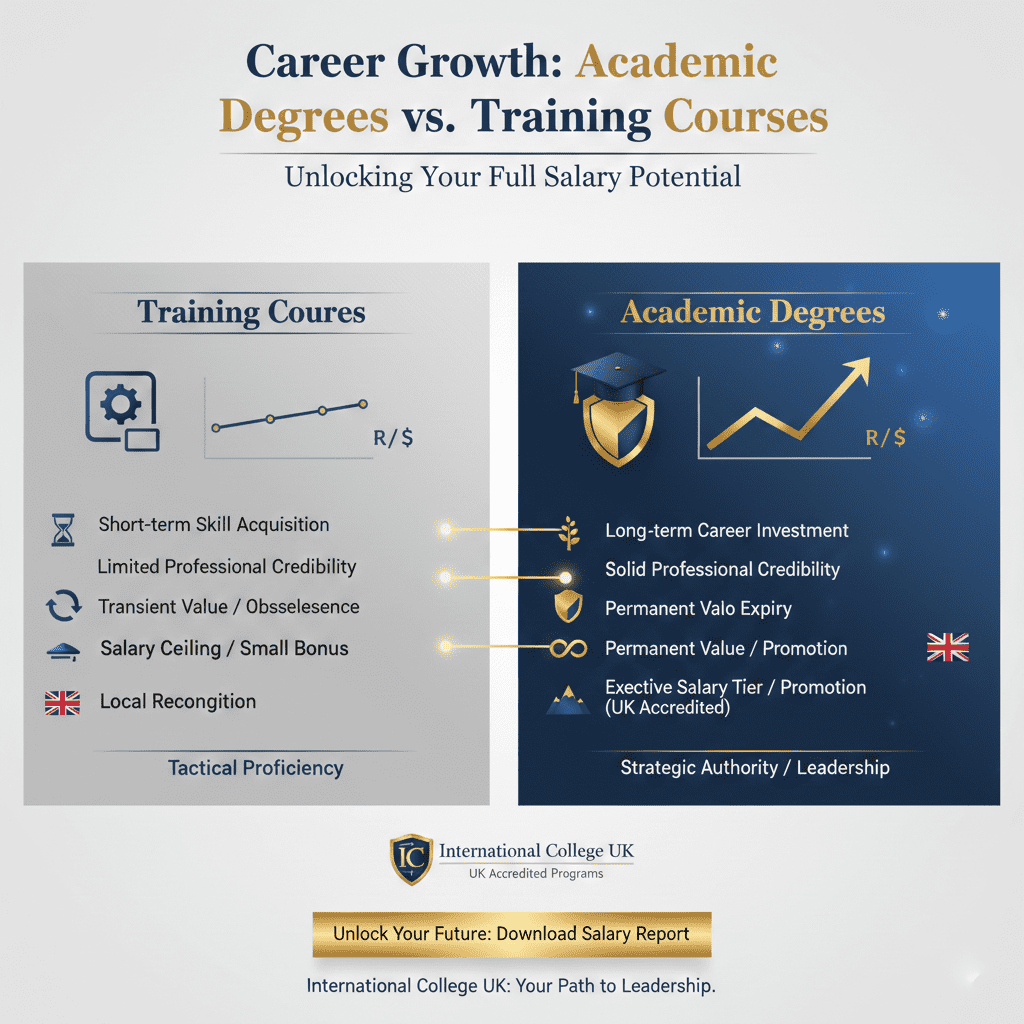
In the hyper-competitive markets of Riyadh and Dubai, every professional eventually hits a "ceiling." You attend workshops, earn digital badges, and complete short-term training courses, yet your position on the corporate salary scale remains stagnant. This is the "Ambition Gap." While training courses are excellent for immediate skill acquisition, they often fail to trigger the structural career shifts required for executive leadership or significant pay raises. The fundamental question every ambitious manager must ask is: "Am I investing in a temporary skill or a permanent asset?" At International College (UK), we specialize in UK Accredited Programs that transform your professional identity. Understanding the strategic difference between a "Training Course" and a formal "Academic Degree" is the key to unlocking the higher echelons of the salary scale and establishing lifelong Professional Credibility. This guide explores why an academic credential is the ultimate ROI for your career.
Training courses (CPD, workshops, and boot camps) are designed for speed. They serve a specific, vital purpose in the modern workplace.
A training course teaches you "how" to do a specific task—how to use a software, how to manage a small team, or how to implement a new policy. These are tactical wins. They keep you relevant in your current role. However, in the eyes of HR departments at major firms like Aramco or multinational corporations in the UAE, training courses are viewed as "maintenance." They prove you are keeping up, but they don't necessarily prove you are ready to lead the entire department.
The "shelf-life" of a training course is often short. As technology and methodologies evolve, the certificate you earned three years ago may become obsolete. While they are lower in cost and time, their impact on your long-term Salary Scale Growth is usually marginal, often resulting in a one-time bonus rather than a permanent grade advancement.
In contrast, an Academic Degree (such as an MBA or an MSc) from a recognized institution like International College UK is a structural investment in your Professional Credibility.
In the GCC region, corporate salary scales are often strictly tiered based on educational attainment. A Master’s degree is frequently a non-negotiable prerequisite for "Grade 12" positions and above in large organizations. By earning a UK Accredited Program degree, you aren't just learning; you are qualifying for a different pay bracket. This is the most significant difference: a degree changes your status within the organization, not just your skill set.
Unlike a software certification, an academic degree never expires. A British degree carries Verifiable UK Quality that remains on your CV for the rest of your life. It is a globally recognized currency that allows for mobility—if you move from Riyadh to London, or from Dubai to Singapore, your academic degree remains a valid, high-value asset, whereas local training courses may lose their luster across borders.
Recruitment and HR managers in the Middle East use academic degrees as a "Trust Signal" to filter candidates for high-responsibility roles.
Completing an Accredited UK College Program requires sustained effort, critical analysis, and the ability to manage complex projects over a long period. This demonstrates to an employer that you possess the resilience and strategic "big-picture" thinking required for senior management—traits that a two-day workshop simply cannot prove.
As established in our previous guides, the ability to secure Embassy Attestation is unique to formal academic credentials. Training certificates rarely, if ever, qualify for this level of official legal recognition. For government sectors and semi-government entities in the KSA and UAE, an attested degree is the only document that officially triggers a salary scale adjustment, providing you with a secure, audit-proof career path.
When looking at the Return on Investment (ROI), the data favor the academic path for those seeking long-term wealth and job security.
Training Course ROI: Immediate, small increase in efficiency; potential for a small bonus; high risk of obsolescence.
Academic Degree ROI: Permanent move to a higher salary bracket; eligibility for executive leadership; enhanced job security during economic shifts; and global career mobility.
At International College UK, our Distance Learning UK model ensures that this ROI is maximized. You don't have to quit your job to earn your degree, meaning you continue to earn while you build the asset that will eventually double or triple your market value.
If your goal is to stay competent in your current role, a training course is sufficient. However, if your ambition is to lead, to command a higher salary, and to establish undeniable Professional Credibility in the global market, an academic degree is the only viable path. In the evolving landscapes of Saudi Vision 2030 and the UAE’s competitive economy, the distinction is clear: training keeps you in the race, but an academic degree from International College (UK) puts you at the finish line. Don't settle for the "ceiling" of short-term courses; invest in the verifiable, attested, and permanent power of a British academic credential.
International College of Economics and Political Science (ICEPS) is an online education provider focused on professional learning, executive development, and career advancement. Our programmes are delivered online.

internationalcollege-online