
Leadership and Innovation
Degrees

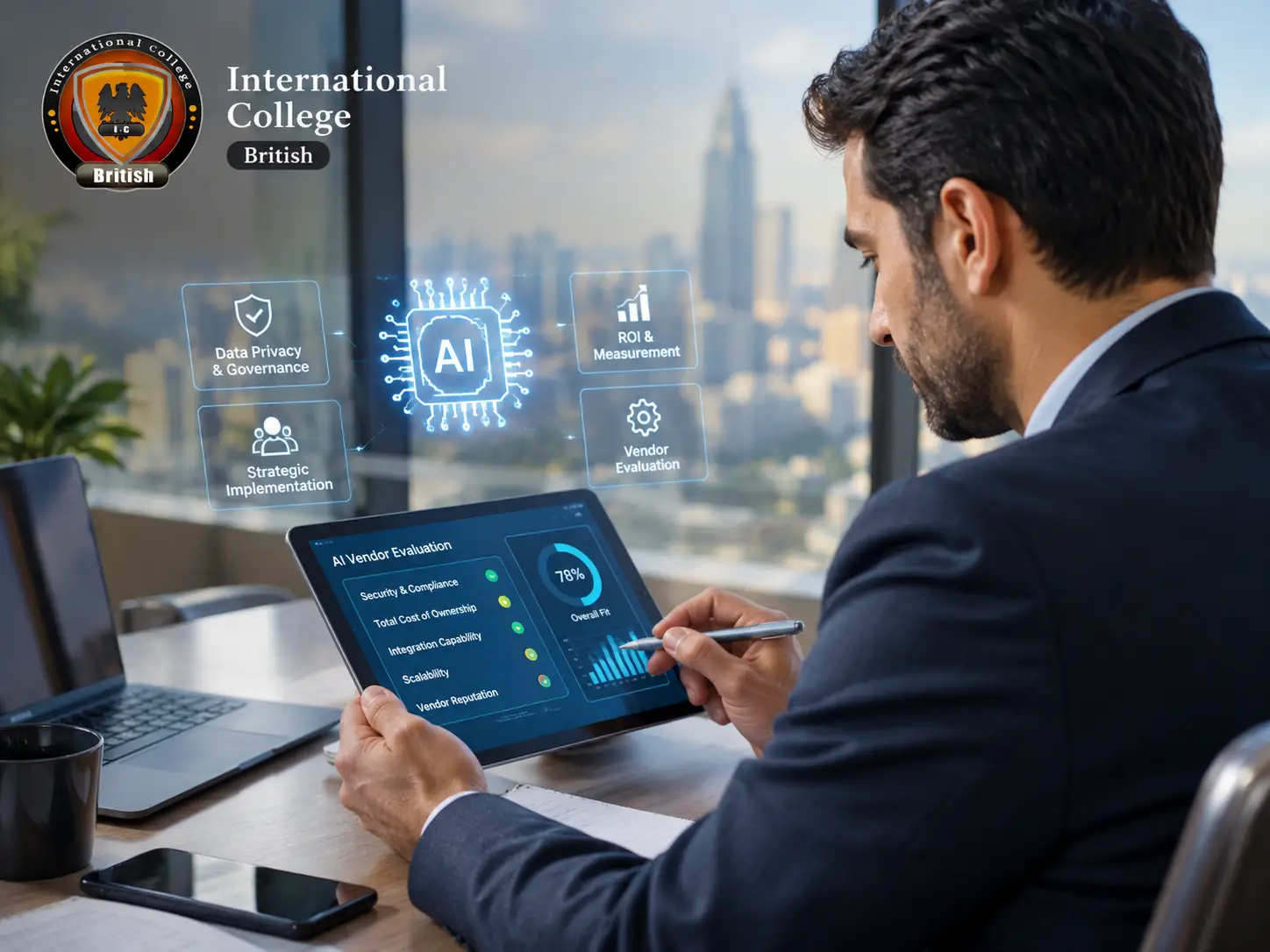
AI courses for managers focus on strategic implementation and risk management rather than software engineering. Developing AI literacy (non-technical) requires mastering vendor evaluation, data privacy frameworks, and ROI measurement, enabling leaders to deploy AI effectively without writing code.
Corporate integration of AI is no longer a technical challenge; it is a management challenge. Working professionals across Egypt and the GCC are actively seeking pathways to upgrade their digital competencies through online and distance learning models. The primary obstacle for managers is identifying which capabilities yield commercial value and which belong strictly to the IT department.
Effective AI skills 2027 demand a structural shift in how leaders view technology. Artificial intelligence for business leaders is fundamentally about procurement, operational integration, and compliance. Exploring this subject through a specialized curriculum offers a high-demand, programme-aligned approach that remains defensible against basic, summary-level content found elsewhere.
Managers frequently waste time acquiring entry-level coding skills that fail to translate into executive capability. The table below delineates the precise competencies non-technical leaders must acquire versus the technical disciplines they should delegate.
|
What Managers Must Learn |
What Managers Must Ignore |
|
Vendor & Model Evaluation: Assessing third-party AI tools for data security, operational fit, and total cost of ownership. |
Algorithm Development: Writing Python scripts, managing neural networks, or building foundational language models. |
|
Data Governance & Ethics: Establishing policies for intellectual property protection, compliance, and bias mitigation in AI outputs. |
Database Engineering: Structuring data lakes, writing SQL queries, or maintaining server infrastructure. |
|
ROI Measurement: Tracking the financial impact, efficiency gains, and productivity metrics of integrated AI tools. |
Deep Prompt Engineering: Memorizing granular, syntax-specific prompts that become obsolete with the next software update. |
|
Change Management: Restructuring workflows, managing employee pushback, and reallocating human capital around AI capabilities. |
API Construction: Building the middleware that connects software applications; this remains an engineering task. |
When selecting AI courses for managers, the delivery format must align with the demands of a working professional's schedule. Educational solutions optimized for distance learning provide working professionals in Egypt and the GCC the ability to balance career progression with rigorous academic study.
Asynchronous Accessibility: Look for programs that allow you to study independently without abandoning a 50-hour work week.
Zero Geographic Friction: High-value distance learning programs require no student visas, travel arrangements, or international accommodation.
Strategic Curriculum: The syllabus must prioritize governance, risk, and deployment over theoretical computer science.
Acquiring AI literacy (non-technical) positions you for cross-functional leadership. By understanding how AI interacts with legal compliance, financial forecasting, and human resources, you transition from a participant in the digital economy to a primary decision-maker.
To capitalize on the growing demand for tech-fluent leadership, integrate these competencies into a recognized qualification. By upgrading your management credentials through a structured, distance-learning curriculum, you secure a highly marketable skill set without interrupting your current employment or relocating internationally. Explore our upcoming intakes and distance learning programs designed specifically for the modern working professional.
International College of Economics and Political Science (ICEPS) is an online education provider focused on professional learning, executive development, and career advancement. Our programmes are delivered online.

internationalcollege-online