
Leadership and Innovation
Degrees

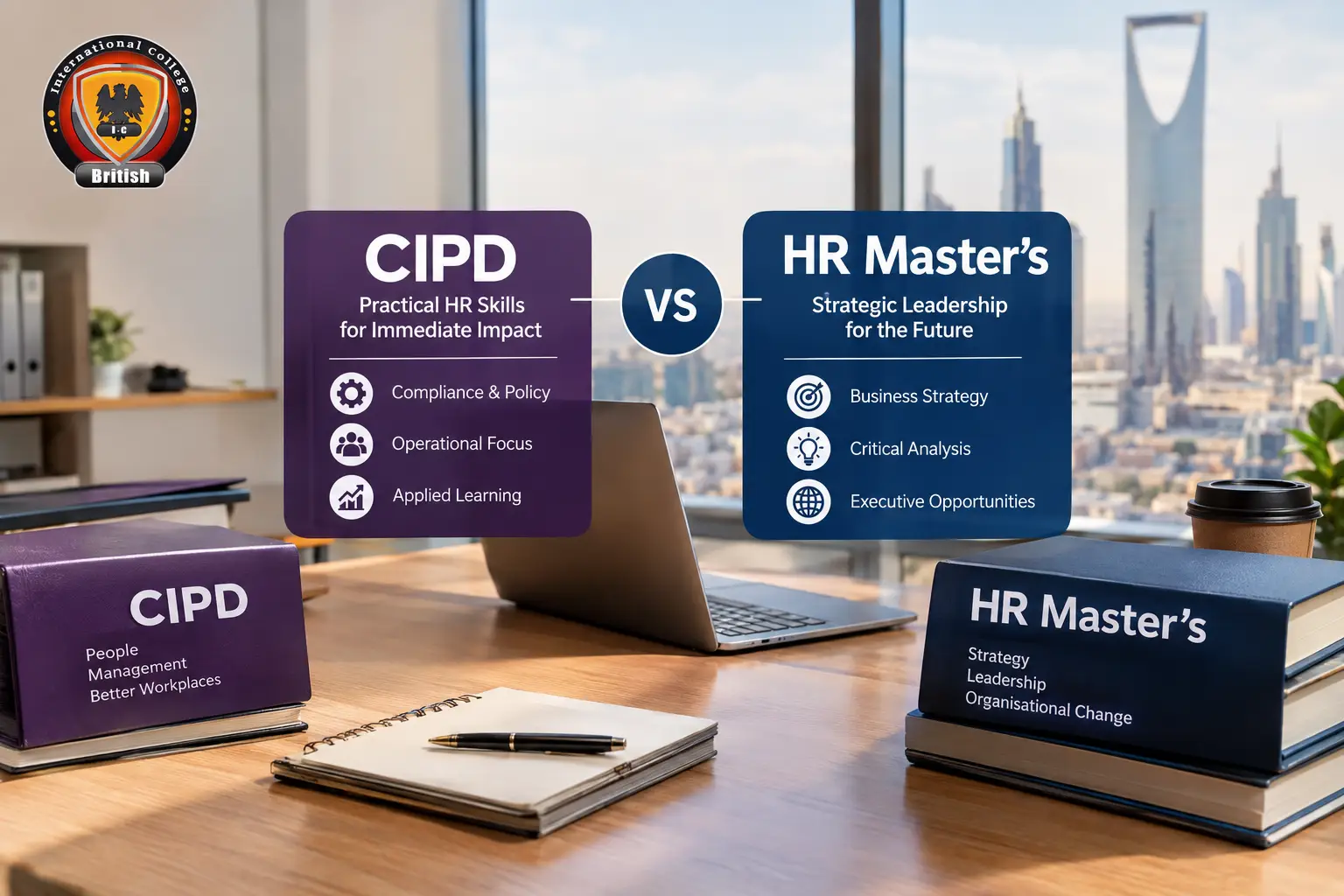
Deciding between a CIPD vs HR masters requires aligning your credential with your specific professional trajectory. The Chartered Institute of Personnel and Development (CIPD) delivers practical, operational frameworks optimized for immediate practitioner implementation. Conversely, an HR Master's degree provides the strategic, academic, and business-leadership rigor required for C-suite executive roles and complex organizational design. Working professionals in Egypt and the GCC can pursue either route via distance learning to accelerate their trajectory without career interruption.
Evaluating a human resources credential comparison begins with understanding the distinct pedagogical frameworks of each qualification. Both credentials signal high-level competence, but they serve entirely different functional purposes within a corporate structure.
A CIPD qualification (particularly at Level 7) is a professional body certification focused heavily on compliance, standardized HR frameworks, and operational execution. It trains professionals to implement established HR policies effectively. An HR Master's degree, typically awarded by a university, is an academic and strategic qualification. It trains leaders to analyze organizational behavior, align human capital with financial objectives, and design the policies that CIPD practitioners execute.
|
Feature |
CIPD (Level 7) |
HR Master's Degree (MSc/MA) |
|
Primary Focus |
Operational HR, compliance, and standardized professional practice. |
Strategic HR, business leadership, and organizational psychology. |
|
Pedagogical Approach |
Competency-based assessments and practical implementation frameworks. |
Academic research, critical analysis, and cross-functional business strategy. |
|
Best Suited For |
HR Generalists, Business Partners, and functional specialists. |
HR Directors, CHROs, and executives transitioning into broader leadership. |
|
Format Suitability |
Phased modular learning. |
Fully adaptable to asynchronous distance learning for working professionals. |
The GCC labor market places a high premium on formalized credentials, utilizing them as primary filters for senior appointments and salary banding. Understanding how regional employers value these qualifications is critical for maximizing your return on investment.
Multinational entities operating in the UAE, KSA, and Qatar often utilize hybrid evaluation models. For mid-level management and specialist roles (e.g., Talent Acquisition Manager, Compensation & Benefits Lead), a CIPD qualification is frequently listed as a hard requirement. However, for regional Head of HR or CHRO positions, corporate boards demand the broad business acumen, financial literacy, and strategic capability demonstrated by a Master's degree.
Nationalization programs across the Gulf mandate robust human capital strategies. Public sector entities and sovereign wealth funds highly prioritize recognized Master's degrees from international institutions. For professionals navigating these sectors, a Master's degree often accelerates grade promotions faster than a professional certificate, particularly when the degree format requires no travel or visa arrangements and can be completed alongside a full-time role.
Selecting the optimal credential requires a forensic look at your current career stage and ultimate executive ambitions.
Consider a CIPD qualification if:
You are transitioning into HR from an unrelated administrative field and need immediate, foundational frameworks.
Your target roles focus heavily on employee relations, standard compliance, and daily HR operations.
Your employer specifically mandates a professional body certification for your next immediate promotion.
Consider an HR Master's Degree if:
You are targeting C-suite, CHRO, or strategic organizational development roles.
You need to interface directly with CFOs and CEOs, requiring a deep understanding of corporate finance, economics, and business strategy.
You want a globally recognized academic credential that transcends regional professional body preferences.
You require the flexibility of a distance-learning model that eliminates the need for international travel, campus residency, or student visas while maintaining full employment.
If you are ready to move beyond operational HR and into strategic executive leadership, explore our distance-learning Master's programmes designed explicitly for working professionals in the MENA region. Secure your place for the upcoming intake and scale your career without stepping away from your current role.
It is considered one of the largest universities, as it has more than 65 accredited training programs. The student in the program obtains internationally accredited certificates and is certified by the study embassy What distinguishes our university from other universities in Britain is the large number of accreditations it enjoys, which makes it at the forefront of international universities that organize professional programs. It is a member of the UK Register of Centers for Education Providers (UKRLP) Search with registration number 10065749. It is also a member of the list of accredited non-governmental organizations of the Economic and Social Council of the United Nations, and also a registered member of the European Union's Transparency Register under the number TR-Q-2017-22003.

internationalcollege-online