
Leadership and Innovation
Degrees

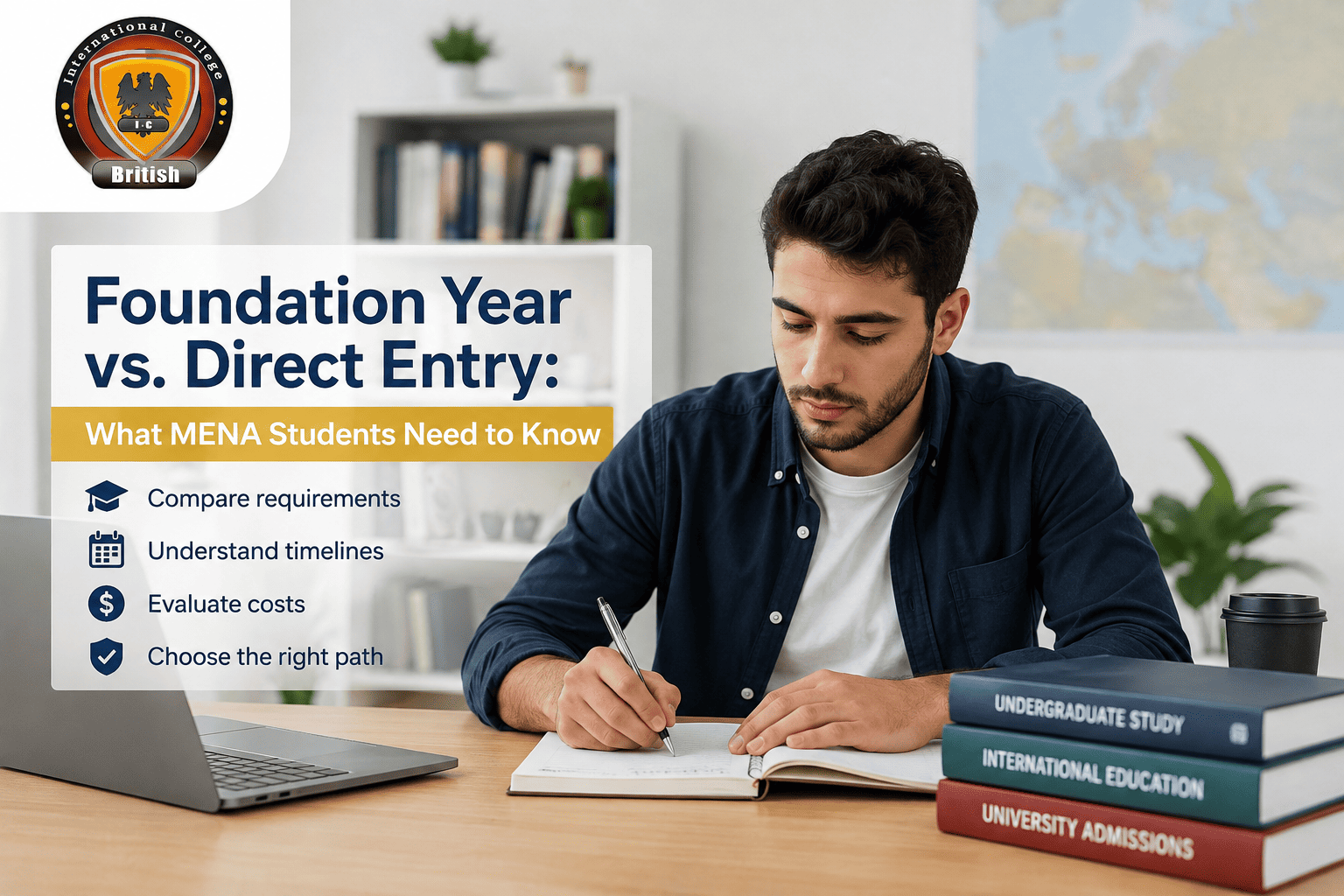
The Quick Answer: A foundation year is a one-year preparatory bridging curriculum designed to transition students from 12-year national school systems (such as Thanaweya Amma or Tawjihi) into 3-year international degree formats, focusing on academic English, subject fundamentals, and study skills. Direct entry admits students straight into Year 1 of a bachelor's program, requiring recognized qualifications like the International Baccalaureate (IB), full A-Levels, or equivalent standardized credentials. For MENA applicants, choosing between the two depends strictly on high school curriculum equivalency, English language test scores (IELTS/TOEFL), and subject-specific prerequisites.
Deciding how to transition from high school to an international university is a major milestone for students across the Middle East and North Africa. The two primary academic routes are the foundation year and direct entry.
[Secondary Education] ───► [Direct Entry] ───────────────► [Year 1 of Degree]
│
└──► [Foundation Year / Bridging Program] ──► [Year 1 of Degree]
An International Foundation Year (IFY)—often referred to as a college bridging program—is an intensive, pre-university preparatory course. It serves three primary functions:
Curriculum Alignment: Fills academic gaps between 12-year secondary diplomas and 13-year university systems (such as the UK or Australian models).
Academic Literacy: Develops university-level research, academic writing, critical thinking, and technical communication.
Subject Specialization: Delivers baseline coursework in chosen disciplines, including STEM, Business, Law, or Humanities.
Successful completion of an integrated foundation program guarantees direct progression into the first year of the targeted undergraduate degree, provided benchmark grades are met.
Direct entry allows a student to enroll immediately into Year 1 (freshman year) of an undergraduate degree without preparatory coursework. This route requires:
Full recognition and equivalency of the student's high school diploma.
High standardized test scores meeting the faculty's specific cutoffs.
Demonstrated English proficiency exceeding institutional minimums (typically IELTS 6.5+ or equivalent).
The structural, financial, and academic differences between both pathways are summarized below:
|
Evaluation Metric |
International Foundation Year (Bridging Program) |
Direct University Entry |
|
Total Program Duration |
1 Prep Year + 3–4 Degree Years (4–5 years total) |
3–4 Degree Years (No prep year added) |
|
Typical Academic Requirement |
National High School Certificate (e.g., Thanaweya Amma, Tawjihi, or standard General Secondary Diploma) with 60%–75%+ |
International credentials (IB Diploma: 28–38+ points; British A-Levels: ABB–A*A*A; US High School Diploma + APs) |
|
English Language Requirement |
IELTS Academic 4.5 – 5.5 (or TOEFL iBT 45 – 65) |
IELTS Academic 6.5 – 7.5 (or TOEFL iBT 85 – 105) |
|
Academic Focus |
50% Academic English & Research Skills; 50% Core Discipline Modules |
100% Degree-Specific Curriculum from Day One |
|
Risk Profile |
Lower academic culture shock; structured ramp-up to tertiary education |
Higher initial academic rigor; zero adjustment period |
|
Financial Commitment |
Adds 1 academic year of tuition and living expenses |
Saves 1 year of total international study costs |
When evaluating university prep programs in MENA versus immediate matriculation, local educational backgrounds play a defining role.
Are you graduating with IB, Full A-Levels, or US Diploma + APs?
├── YES ──► Meets Faculty Cutoffs & IELTS 6.5+?
│ ├── YES ──► DIRECT ENTRY
│ └── NO ──► INTEGRATED FOUNDATION / PATHWAY
│
└── NO (National Diploma: Thanaweya Amma, Tawjihi, GCC National Secondary)
│
└──► FOUNDATION YEAR / BRIDGING PROGRAM REQUIRED
National Curricula (Thanaweya Amma, Tawjihi, GCC State Diplomas): Most international universities in the UK, Europe, and Australia do not consider 12-year national diplomas directly equivalent to their Year 13 standard. A foundation year is generally mandatory for these students.
International Curricula (IB, Cambridge A-Levels, American Diploma): Students graduating from international schools in Cairo, Riyadh, Dubai, or Doha who achieve full diploma credentials and competitive exam scores qualify directly for Year 1.
Passing an English proficiency exam does not automatically guarantee comfort with university-level writing, oral defense, and citations.
A foundation year trains students in APA/Harvard referencing, thesis development, and seminar presentation skills.
Direct entry demands that students hit the ground running with 3,000-word essays, lab reports, and seminar debates from their first week.
While direct entry saves a full year of international tuition and living expenses, entering Year 1 unprepared can carry hidden risks:
Failing first-year degree modules can result in academic probation or repeating an entire academic year at full degree tuition rates.
A foundation year acts as an insurance policy, boosting overall degree classification outcomes and reducing dropout risk.
Audit Your Secondary Certificate: Verify whether your target institution classifies your specific diploma as "Direct Entry Eligible."
Review Conditional Offers: If your final grades or language scores fall slightly below direct admission thresholds, ask the admissions office about an integrated foundation route.
Assess Subject Prerequisites: Highly competitive tracks (e.g., Engineering, Computer Science, Medicine) often demand specific pre-calculus or science prerequisites that national curriculums may not fully cover.
Evaluate Academic Confidence: Consider whether an adjustment year will benefit your long-term Grade Point Average (GPA) and career trajectory.
Neither route is universally superior; each solves a different academic need:
Select Direct Entry if you hold recognized international credentials (IB, A-Levels, APs), exceed language benchmarks, and are ready for self-directed study.
Select a Foundation Year if you hold a national secondary certificate, need to boost your academic English, or want a structured transition into a foreign education system.
Speak with an international admissions advisor to evaluate your high school transcript, verify credit equivalencies, and secure the right degree pathway for the upcoming academic intake.
It is considered one of the largest universities, as it has more than 65 accredited training programs. The student in the program obtains internationally accredited certificates and is certified by the study embassy What distinguishes our university from other universities in Britain is the large number of accreditations it enjoys, which makes it at the forefront of international universities that organize professional programs. It is a member of the UK Register of Centers for Education Providers (UKRLP) Search with registration number 10065749. It is also a member of the list of accredited non-governmental organizations of the Economic and Social Council of the United Nations, and also a registered member of the European Union's Transparency Register under the number TR-Q-2017-22003.
internationalcollege-online