
Leadership and Innovation
Degrees

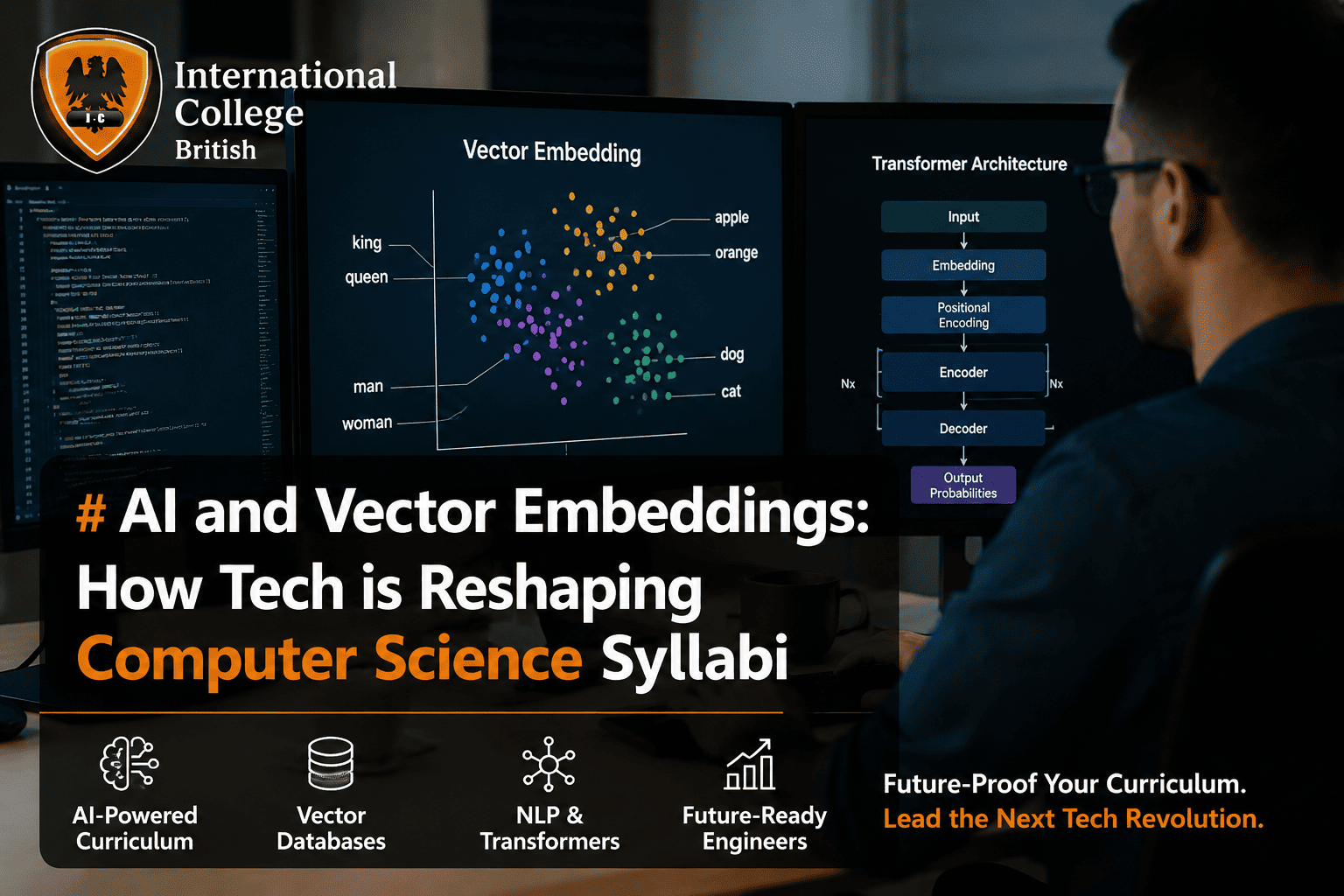
The modern Computer science syllabus AI requires a radical shift from legacy software engineering to applied machine learning and data architecture. Top-tier universities are restructuring programs to prioritize vector embeddings education, neural network architectures, and advanced Natural Language Processing (NLP). This curriculum overhaul directly aligns future tech degrees with enterprise demands for engineers capable of building scalable, context-aware AI systems.
Academic institutions can no longer rely on static algorithms and traditional relational database management. The baseline requirement for software engineering has shifted toward cognitive systems and generative models. Upgrading the Computer science syllabus AI involves integrating complex computational frameworks directly into foundational courses, rather than isolating them as senior-year electives.
Current curriculum strategies mandate the inclusion of heavy Natural Language Processing (NLP) frameworks and theoretical jargon early in the academic lifecycle to build necessary topical depth. This ensures graduates do not just utilize APIs, but understand the mathematical weight of the underlying models.
Algorithmic Complexity: Shifting focus from basic sorting algorithms to gradient descent and backpropagation optimization.
Data Architecture: Transitioning from strictly structured SQL databases to high-dimensional vector databases (e.g., Pinecone, Milvus).
System Design: Designing architectures capable of Retrieval-Augmented Generation (RAG) and low-latency inference.
|
Curriculum Component |
Legacy CS Syllabus |
Modern AI-Driven Syllabus |
|
Data Storage |
Relational Databases (SQL), Normalization |
Vector Databases, Unstructured Data Pipelines |
|
Core Mathematics |
Discrete Math, Basic Statistics |
Linear Algebra (Tensors), Multivariable Calculus |
|
Search & Retrieval |
Keyword/Boolean Search, TF-IDF |
Semantic Search, K-Nearest Neighbors (KNN) |
|
Software Architecture |
Monolithic & Microservices |
Distributed Machine Learning Ops (MLOps) |
A foundational understanding of high-dimensional space is non-negotiable for modern software engineers. Vector embeddings education bridges the gap between raw data and machine comprehension. Programs are now demanding students understand how to convert text, image, and audio inputs into dense numerical vectors that capture semantic relationships.
Teaching vector embeddings requires rigorous mathematical foundations. Students must master measuring semantic similarity through cosine similarity, Euclidean distance, and dot products. By embedding these concepts into the sophomore and junior years, universities produce engineers who can optimize the latent space of transformer models, rather than merely treating them as black boxes.
The architecture of future tech degrees relies heavily on producing talent fluent in Natural Language Processing. As the digital economy scales, the demand for contextual, conversational, and autonomous AI systems dictates the academic roadmap.
To bridge the gap between academia and industry, degree programs are enforcing strict competencies in modern NLP pipelines:
Transformer Architectures: Comprehensive study of self-attention mechanisms and positional encoding.
Tokenization Strategies: Mastery of Byte-Pair Encoding (BPE) and WordPiece models for optimal context window management.
Fine-Tuning Methodologies: Practical application of Low-Rank Adaptation (LoRA) and quantization techniques for deploying large language models on edge devices.
Information Gain: Utilizing semantic indexing to extract high-value insights from vast, unstructured datasets.
Institutions failing to integrate these specific NLP and vector concepts risk graduating obsolete engineers. The academic standard now requires a synthesis of pure computational theory with scalable AI deployment strategies.
Evaluate your institution's tech curriculum against 2026 industry standards. Download our comprehensive curriculum mapping framework to integrate scalable AI and vector embedding modules into your existing degree programs today.
It is considered one of the largest universities, as it has more than 65 accredited training programs. The student in the program obtains internationally accredited certificates and is certified by the study embassy What distinguishes our university from other universities in Britain is the large number of accreditations it enjoys, which makes it at the forefront of international universities that organize professional programs. It is a member of the UK Register of Centers for Education Providers (UKRLP) Search with registration number 10065749. It is also a member of the list of accredited non-governmental organizations of the Economic and Social Council of the United Nations, and also a registered member of the European Union's Transparency Register under the number TR-Q-2017-22003.

internationalcollege-online