
Leadership and Innovation
Degrees

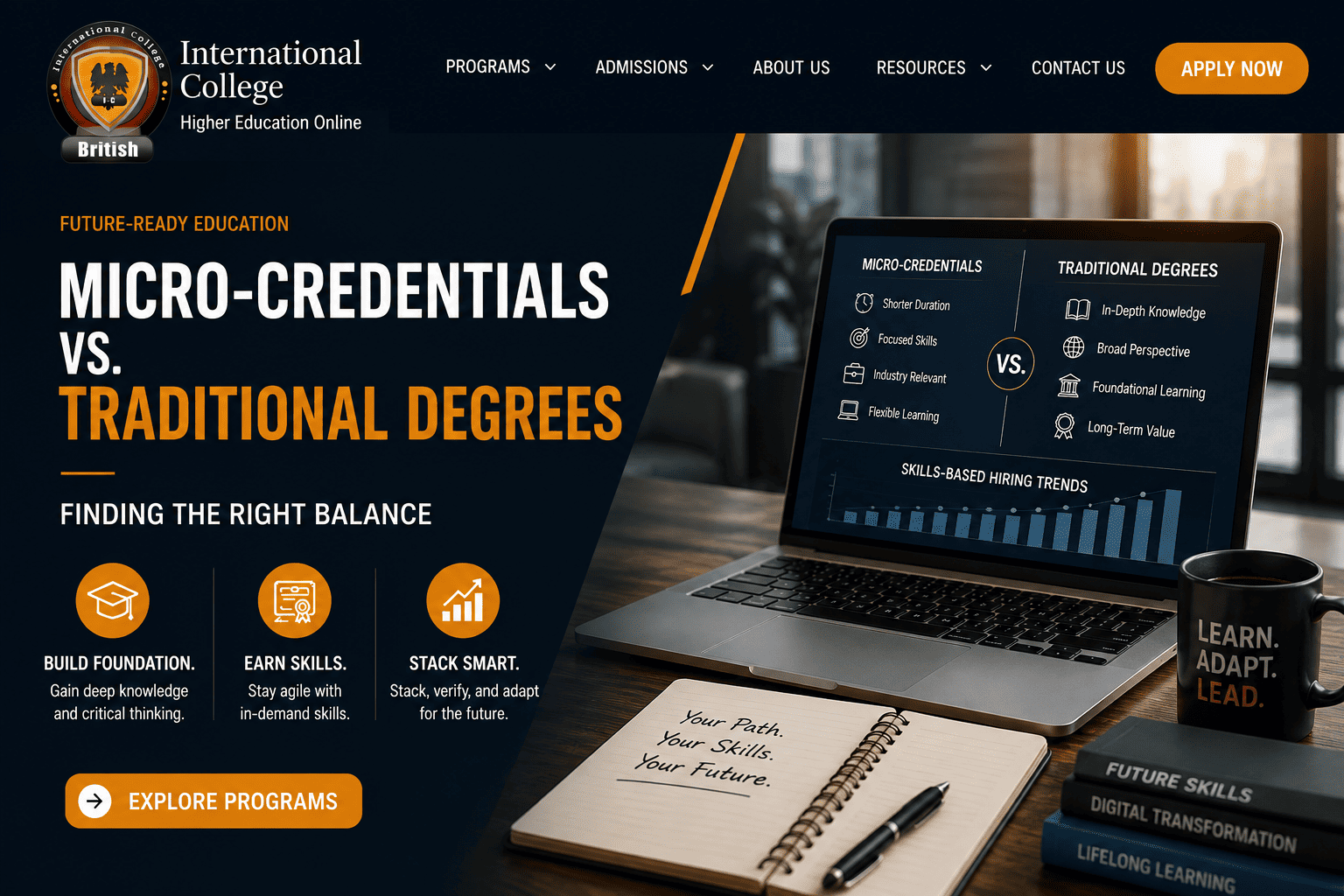
The modern labor market demands both foundational knowledge and rapid skill adaptation, shifting the hiring paradigm from binary credentialing to a hybrid model. While traditional degrees remain a durable proxy for cognitive capacity and broad capability, micro-credentials offer the precision and speed necessary to master rapidly shifting technological requirements. Organizations and professionals achieve the highest ROI by leveraging alternative education tech to stack targeted micro-credentials on top of formal degrees, directly aligning educational outcomes with modern agile tech trends.
The debate regarding micro-credentials vs degrees often centers on displacement—the flawed assumption that short-form certifications will render universities obsolete. In reality, these two tracks solve fundamentally different problems within the human resources lifecycle. They project different economic signals to employers regarding a candidate's readiness and risk profile.
A four-year degree forces individuals to build knowledge across a discipline, developing durable capabilities such as analytical thinking, complex problem-solving, and communication. This long-term academic discipline functions as a robust proxy for baseline competency. However, traditional curricula are structurally slow to adapt.
Conversely, micro-credentials solve the relevance problem. They are modular, highly targeted interventions that verify a candidate possesses current, immediately applicable skills—particularly in technical domains like artificial intelligence, data analytics, and digital marketing.
When analyzing educational outcomes compared to modern agile tech trends, the contrast in utility becomes stark:
|
Evaluation Metric |
Traditional Degrees |
Micro-Credentials |
|
Core Economic Signal |
Foundational credibility and cognitive durability. |
Specialized relevance and current skill application. |
|
Time-to-Market |
2 to 4+ years. |
4 to 12 weeks. |
|
Curriculum Agility |
Low (Rigid accreditation processes delay updates). |
High (Dynamically aligned with immediate industry shifts). |
|
Strategic Utility |
Executive leadership, baseline professional entry. |
Upskilling, reskilling, mitigating technological automation risks. |
The World Economic Forum projects that nearly 40% of workers' core skills will require updating by 2030 due to technological disruption. This acceleration is forcing a transition from credential-based hiring to skills-based hiring. Employers are increasingly looking for demonstrable capabilities rather than relying solely on the prestige of an institution.
This shift has catalyzed the adoption of stackable credentials. Rather than viewing education as a discrete phase completed in early adulthood, the modern workforce demands a continuous, iterative learning model.
Modularity: Professionals can acquire specific competencies as required by their immediate project needs.
Interoperability: Verifiable digital formats (such as OpenBadge standards) allow credentials to be recognized seamlessly across different platforms and international borders.
Targeted Application: Focused training directly reduces onboarding costs and accelerates the timeline to peak productivity.
Nowhere is the need for agile education more pronounced than in rapidly developing economies. The adoption of college certificates MENA represents a structural realignment of the region's talent pipeline. National economic transformation visions across the GCC demand a workforce fluent in emerging technologies, sustainable business practices, and advanced engineering.
By integrating modular learning frameworks, academic institutions in the MENA region are bypassing the bureaucratic lag of traditional curriculum development. These short-form certificates provide local youth and expatriate talent with direct pathways to employability in high-growth sectors, bridging the historical disconnect between academic theory and immediate corporate demands.
The future of workforce readiness relies heavily on alternative education tech to build personalized, verifiable, and continuously updated learning networks. The most resilient professionals will not choose between a degree and a micro-credential; they will utilize technology to combine them.
Organizations must adjust their talent acquisition and development frameworks to recognize this new educational architecture. This involves upgrading Applicant Tracking Systems (ATS) to parse and validate digital micro-credentials with the same weight traditionally reserved for university diplomas.
To find the right balance, institutional leaders and individual professionals should implement the following structural approach:
Establish the Foundation: Utilize traditional degrees to build macro-level critical thinking, industry context, and professional networks.
Deploy Targeted Upskilling: Leverage micro-credentials to master specific software frameworks, methodologies, or emerging tech trends that degrade rapidly in value.
Validate Continuously: Use alternative education platforms to maintain a dynamic, verifiable portfolio of competencies that evolves alongside industry requirements.
Ready to future-proof your career or corporate talent pipeline?
Explore our comprehensive directory of verified micro-credentials and adaptive degree programs to start building your stackable education portfolio today. [Explore Programs Now]
It is considered one of the largest universities, as it has more than 65 accredited training programs. The student in the program obtains internationally accredited certificates and is certified by the study embassy What distinguishes our university from other universities in Britain is the large number of accreditations it enjoys, which makes it at the forefront of international universities that organize professional programs. It is a member of the UK Register of Centers for Education Providers (UKRLP) Search with registration number 10065749. It is also a member of the list of accredited non-governmental organizations of the Economic and Social Council of the United Nations, and also a registered member of the European Union's Transparency Register under the number TR-Q-2017-22003.
internationalcollege-online