
Leadership and Innovation
Degrees

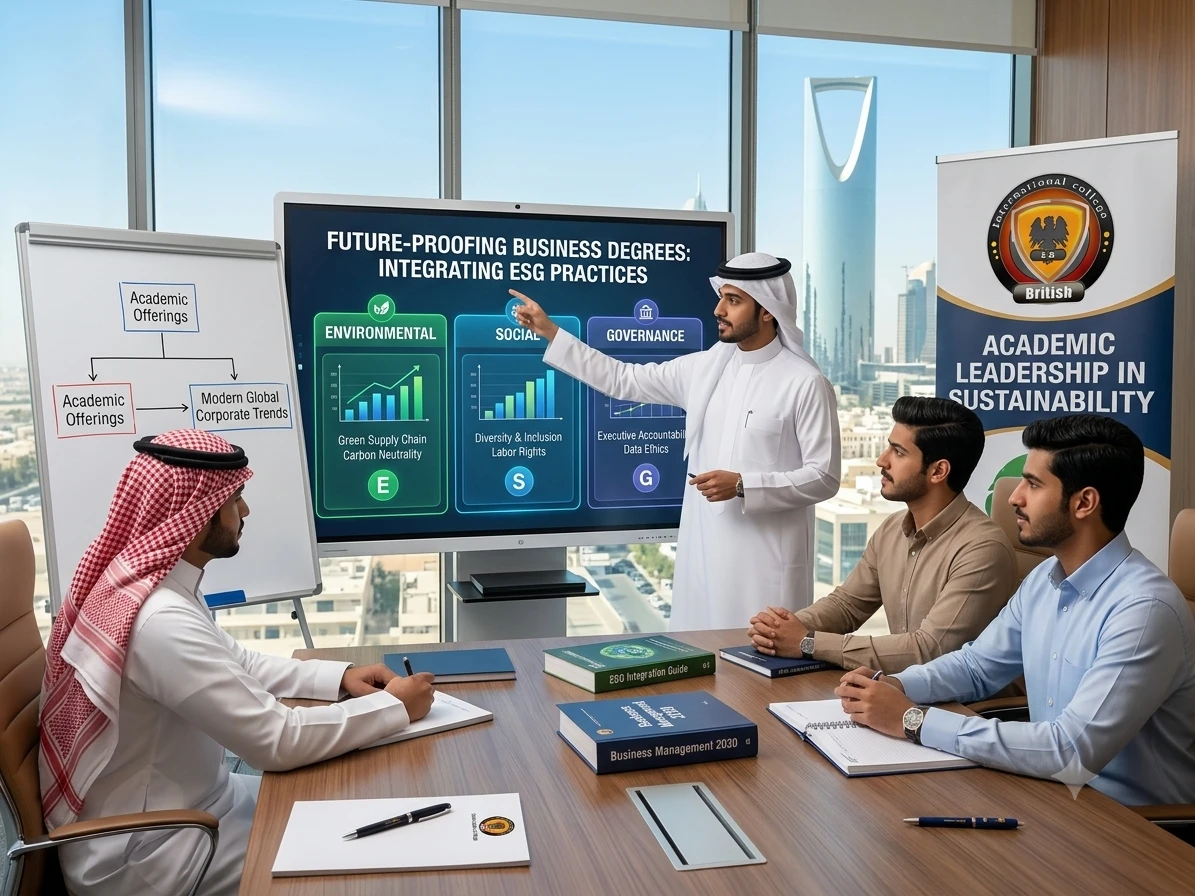
The global corporate landscape has fundamentally shifted, positioning Environmental, Social, and Governance (ESG) criteria not merely as ethical guidelines, but as core drivers of financial performance and risk management. To remain relevant, modern academic institutions must align their business degrees with these global corporate trends. By integrating sustainable ESG practices directly into the curriculum, business schools can future-proof their graduates, ensuring they enter the market equipped to navigate complex regulatory frameworks and lead sustainable corporate transformations.
Historically, business education focused heavily on shareholder primacy and short-term profit maximization. However, modern corporate trends indicate a rapid pivot toward stakeholder capitalism. Global regulatory bodies, institutional investors, and consumers now demand transparent sustainability practices.
For academic institutions, this means traditional curricula are no longer sufficient. Future-proofing a business degree requires moving beyond theoretical ethics classes and embedding ESG metrics into the hard skills of finance, operations, and strategic management. Graduates must be prepared to answer how corporate decisions impact carbon footprints, labor equity, and board transparency.
To bridge the gap between academic offerings and corporate realities, forward-thinking business programs are restructuring their core modules around the three pillars of ESG:
Modern business degrees must incorporate environmental risk assessment into operational training. This includes:
Green Supply Chain Management: Teaching students how to audit and optimize supply chains for carbon neutrality and resource efficiency.
Climate Finance: Integrating carbon pricing, green bonds, and sustainable investment strategies into traditional financial modeling.
Corporate success is increasingly tied to human capital management and community impact. Curricula should cover:
Diversity, Equity, and Inclusion (DEI): Formulating structural policies that go beyond compliance to foster genuine innovation through diverse workforces.
Labor Rights & Fair Trade: Analyzing global labor laws and the social impact of international corporate expansion.
Strong governance is the bedrock of corporate longevity. Academic integration requires focusing on:
Executive Accountability: Training future leaders in transparent executive compensation structures and anti-corruption protocols.
Board Diversity & Data Ethics: Navigating the legal and ethical frameworks surrounding consumer data protection and ethical AI deployment.
The transition from a standard business degree to a future-proofed, ESG-integrated model involves a structural overhaul of how success is taught and measured.
|
Educational Focus |
Traditional Business Degree |
ESG-Integrated Business Degree |
|
Primary Metric of Success |
Shareholder Value & Profitability |
Stakeholder Value & Long-term Sustainability |
|
Risk Management |
Financial and Market Volatility |
Climate, Social, and Regulatory Risks |
|
Supply Chain Focus |
Cost Reduction and Speed |
Ethical Sourcing and Carbon Footprint |
|
Corporate Reporting |
Standard Financial Statements (GAAP/IFRS) |
Integrated Reporting (Sustainability & Financials) |
The strategic advantage of integrating ESG into business degrees lies in direct market alignment. Top-tier global consultancies, financial institutions, and multinational corporations are aggressively recruiting talent fluent in sustainability frameworks.
When academic institutions embed these practices into their core offerings, they signal immediate market readiness. Students transition from being mere observers of corporate trends to active architects of sustainable business strategies. This alignment not only elevates the prestige of the academic institution but ensures an exceptionally high return on investment (ROI) for the graduate navigating the future economy.
It is considered one of the largest universities, as it has more than 65 accredited training programs. The student in the program obtains internationally accredited certificates and is certified by the study embassy What distinguishes our university from other universities in Britain is the large number of accreditations it enjoys, which makes it at the forefront of international universities that organize professional programs. It is a member of the UK Register of Centers for Education Providers (UKRLP) Search with registration number 10065749. It is also a member of the list of accredited non-governmental organizations of the Economic and Social Council of the United Nations, and also a registered member of the European Union's Transparency Register under the number TR-Q-2017-22003.

internationalcollege-online