
Leadership and Innovation
Degrees

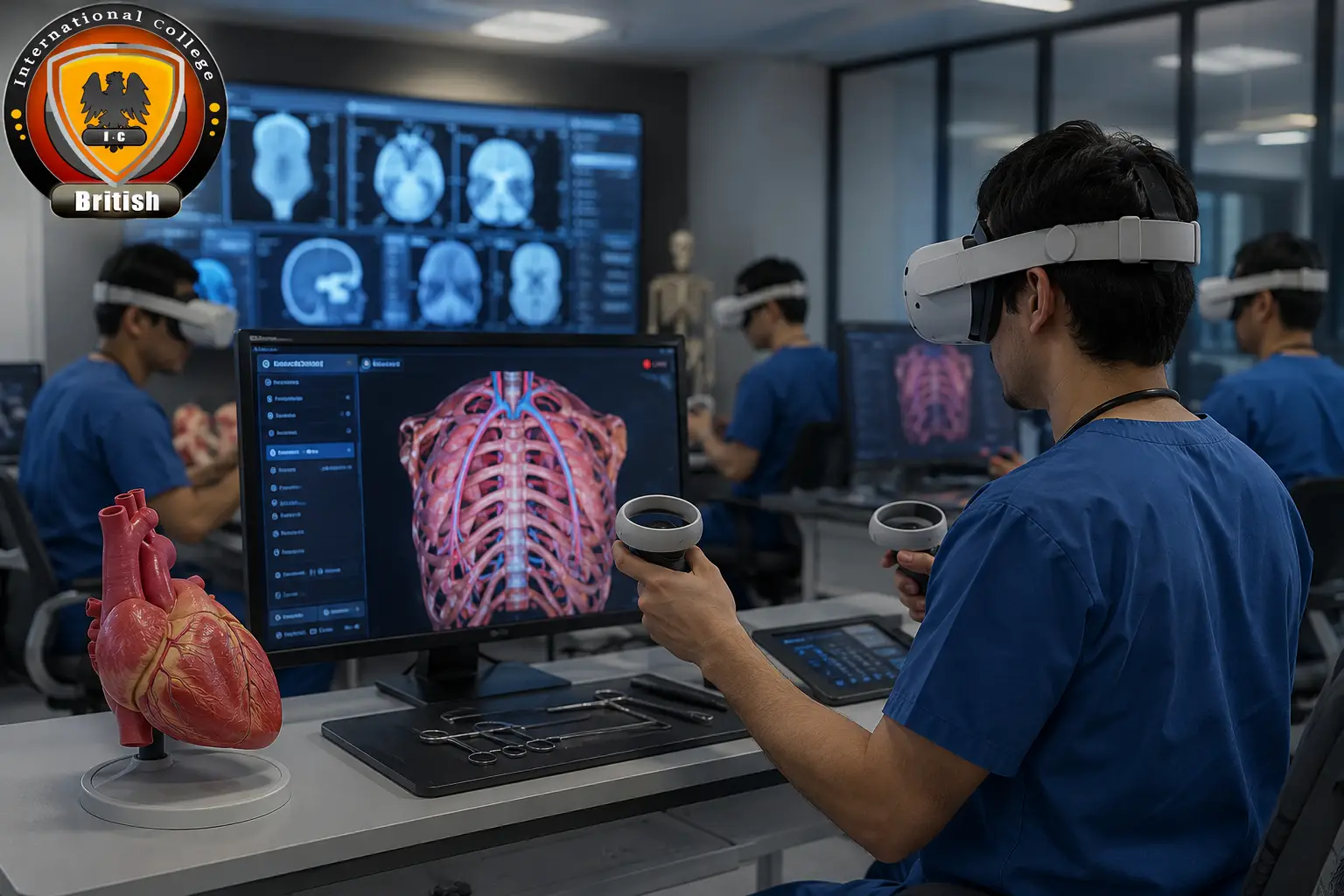
Quick Summary: VR in medical studies replaces traditional cadaveric dissection with hyper-realistic, repeatable 3D anatomical simulations. Modern virtual reality college labs reduce institutional overhead while exponentially increasing student surgical proficiency through zero-risk training environments. This critical evolution in medical degrees tech allows institutions to accurately evaluate precision, decision-making, and spatial awareness long before students enter actual clinical rotations.
For decades, early-stage medical education relied strictly on 2D textbook diagrams and physical cadaver dissection. While foundational, these methods present hard limits on repetition and rare pathology exposure. The integration of VR in medical studies fundamentally shifts the pedagogical model from passive observation to active, spatial immersion.
Medical students can now step into highly detailed digital operating theaters to interact with 3D human anatomy. This allows for immediate visual feedback and the ability to isolate specific biological systems—such as the cardiovascular or nervous system—in real-time, a physical impossibility in traditional labs.
Physical anatomy labs carry significant logistical, financial, and ethical constraints. Virtual reality college labs bypass these bottlenecks, democratizing access to high-tier medical training regardless of geographic limitations or resource scarcity.
|
Feature |
Traditional Cadaver Labs |
Virtual Reality College Labs |
|
Accessibility |
Limited by supply and strict laboratory hours. |
24/7 on-demand access from any approved terminal. |
|
Error Cost |
High. Tissue dissection cannot be undone. |
Zero. Procedures can be reset and repeated infinitely. |
|
Pathology Exposure |
Restricted to the specific condition of the cadaver. |
Unlimited access to rare anomalies and varied patient demographics. |
|
Institutional Cost |
High recurring costs for storage, ventilation, and procurement. |
High initial capital expenditure, drastically lower ongoing maintenance. |
The efficacy of medical degrees tech relies entirely on the fidelity of the simulation. Modern VR architectures utilize advanced spatial computing to ensure the virtual environment perfectly mimics the physical constraints of a real operating room.
Institutions deploying these systems rely on three critical technological pillars:
Haptic Feedback Systems: Advanced hand controllers provide physical resistance, mimicking the exact tactile sensation of cutting through different tissue densities or striking bone.
Dynamic Physiological Responses: AI-driven virtual patients react in real-time to surgical errors, triggering drops in virtual blood pressure or heart rate to train students in high-stress crisis management.
Cloud-Based Collaboration: Multi-user VR environments allow a specialized surgeon in one country to simultaneously guide medical students across the globe through a complex, synchronized virtual procedure.
Data tracking within VR environments provides unprecedented analytical depth. Instead of subjective human grading, software algorithms track a student’s exact instrument angles, millimeter precision, and reaction times. This accelerates the acquisition of muscle memory. By the time students transition to physical surgical residencies, their spatial awareness and procedural confidence are measurably higher, directly mitigating early-career clinical errors.
Forward-thinking global colleges are rewriting their curricula to mandate VR proficiency as a graduation requirement. This is not supplementary technology; it is the new baseline for medical accreditation. As healthcare systems globally face mounting pressure to produce highly skilled practitioners rapidly, immersive technology bridges the gap between academic theory and clinical execution. Institutions that fail to adopt robust virtual infrastructure risk rendering their medical graduates uncompetitive in a technologically advanced healthcare market.
To stay updated on the latest breakthroughs in medical degrees tech and global educational strategies, follow our professional social media page.
Join the conversation and ensure you never miss our executive deep dives into the future of healthcare education.
It is considered one of the largest universities, as it has more than 65 accredited training programs. The student in the program obtains internationally accredited certificates and is certified by the study embassy What distinguishes our university from other universities in Britain is the large number of accreditations it enjoys, which makes it at the forefront of international universities that organize professional programs. It is a member of the UK Register of Centers for Education Providers (UKRLP) Search with registration number 10065749. It is also a member of the list of accredited non-governmental organizations of the Economic and Social Council of the United Nations, and also a registered member of the European Union's Transparency Register under the number TR-Q-2017-22003.

internationalcollege-online