
Leadership and Innovation
Degrees

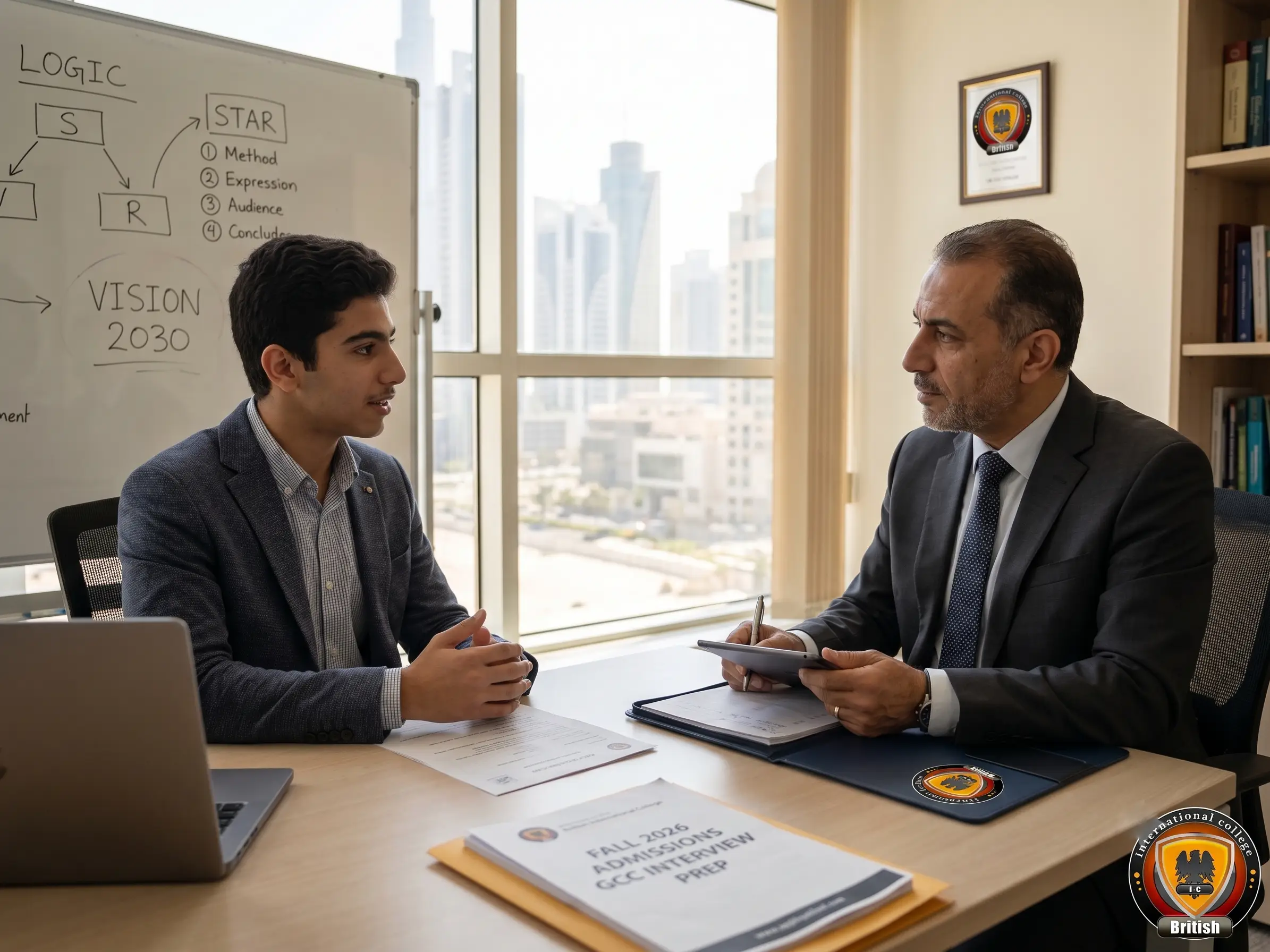
Securing fall admissions requires candidates to transcend generic scripting and master international college interviews by demonstrating cognitive agility and precise academic intent. Executing structured college interview prep GCC transitions applicants from passive respondents to strategic conversationalists. By decoding high-probability interview questions MENA applicants face, this guide provides the direct response frameworks necessary to build early engagement for fall cycles.
Top-tier academic institutions no longer utilize interviews merely to assess cultural fit; they function as rigorous evaluations of a candidate's cognitive adaptability and future academic ROI. Admissions committees prioritize applicants who articulate a clear trajectory, demonstrating intellectual agility and the capacity to leverage emerging technologies or methodologies within their chosen disciplines.
Succeeding in international college interviews demands replacing rehearsed recitations with dynamic, evidence-based dialogue. Candidates must project institutional authority, proving their academic objectives align systematically with the university's research output or corporate placement goals. Targeting these exact skill evolutions during the interview signals premium candidate status to evaluation boards.
Anticipating the structural intent behind admissions inquiries is the foundation of high-yield preparation. Global universities tailor their questioning to extract specific psychological and academic markers. Below is an analytical breakdown of primary interview questions MENA students must master to neutralize early-cycle objections and secure their placement.
|
Question Typology |
Admissions Intent |
Strategic Response Framework |
|
The Cognitive Pivot |
Assessing adaptability, analytical reasoning, and problem-solving in unstructured academic or geopolitical scenarios. |
Employ the STAR method to detail a specific academic or leadership challenge, emphasizing verifiable recovery metrics and critical decision-making. |
|
Global & Regional Integration |
Evaluating cross-cultural intelligence and readiness for diverse, high-performance campus ecosystems. |
Highlight collaborative projects spanning international boundaries or localized community impact initiatives within high-value GCC markets. |
|
The Forward-Looking ROI |
Measuring the candidate's long-term career trajectory against systemic industry and economic shifts. |
Articulate a clear post-graduate roadmap, specifically mentioning integration with regional macro-trends like Vision 2030 or advanced corporate ecosystems. |
Securing a definitive acceptance requires institutionalizing your preparation methodology. Ad hoc practice yields inconsistent performance. Implement this structured college interview prep GCC protocol as a commercial insight strategy to build early engagement for fall cycles:
Simulate High-Friction Environments: Conduct mock interviews utilizing varied pacing, deliberate interruptions, and unpredictable questioning sequences to build executive presence and stress resilience under pressure.
Audit Application Symmetry: Align your verbal narrative flawlessly with your submitted transcripts and personal statements. Inconsistencies between spoken responses and written documentation immediately flag applications for rejection.
Formulate High-Yield Inquiries: Prepare highly specific, faculty-directed questions for the interviewer. Inquiring about specialized campus incubators, localized research grants, or specific curriculum adaptations demonstrates deep investigative effort.
Do not leave your upcoming admissions cycle to chance. Transition your application from pending to accepted by mastering the critical evaluation phase. Schedule your comprehensive interview preparation diagnostic with our lead admissions strategist today to execute your strategy and secure your fall 2026 placement.
It is considered one of the largest universities, as it has more than 65 accredited training programs. The student in the program obtains internationally accredited certificates and is certified by the study embassy What distinguishes our university from other universities in Britain is the large number of accreditations it enjoys, which makes it at the forefront of international universities that organize professional programs. It is a member of the UK Register of Centers for Education Providers (UKRLP) Search with registration number 10065749. It is also a member of the list of accredited non-governmental organizations of the Economic and Social Council of the United Nations, and also a registered member of the European Union's Transparency Register under the number TR-Q-2017-22003.

internationalcollege-online