
Leadership and Innovation
Degrees

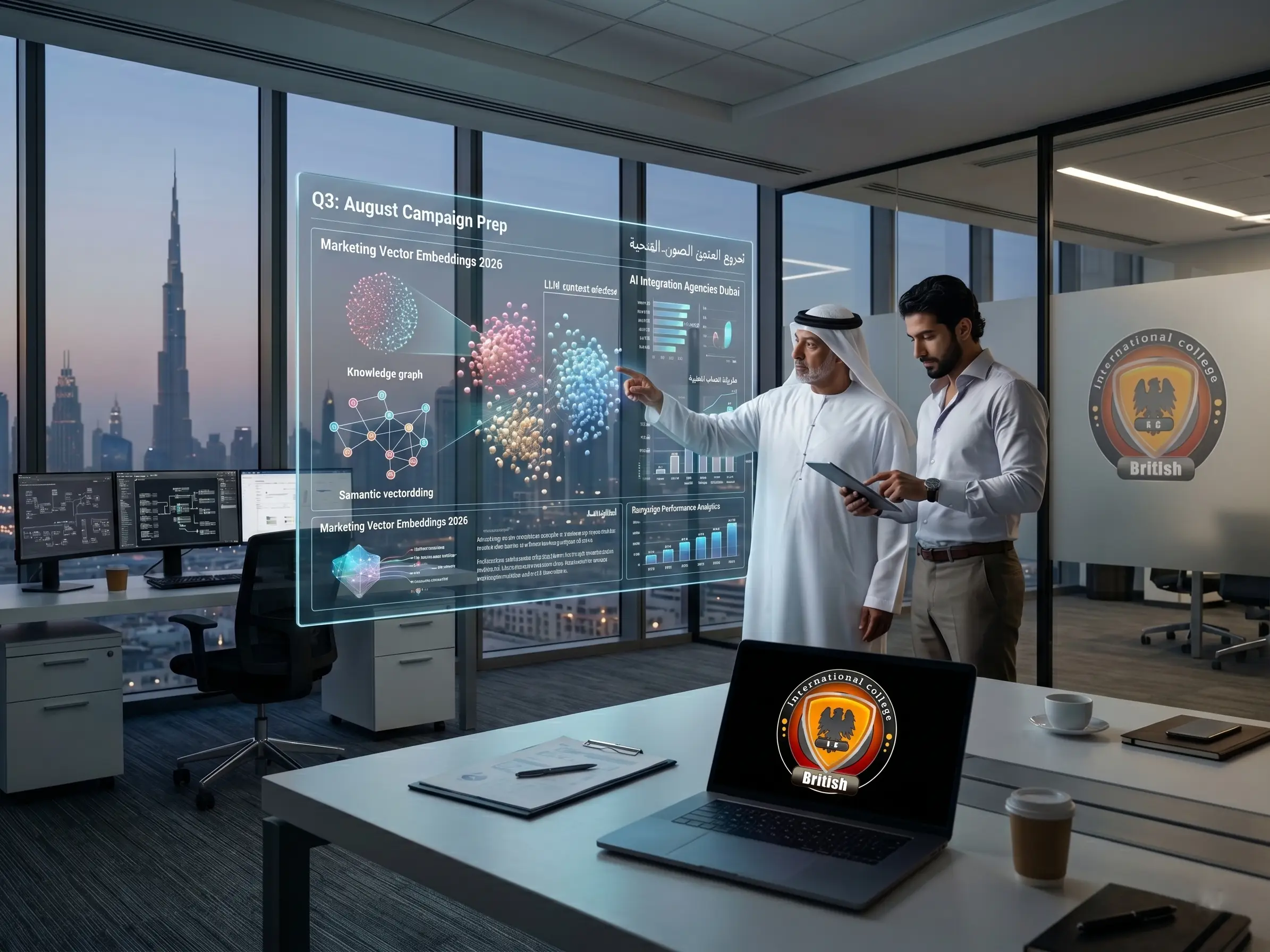
Executing Q3 marketing operations requires an immediate departure from flat relational databases toward multidimensional semantic architectures. Integrating Marketing Vector Embeddings 2026 frameworks allows enterprise teams to mathematically map consumer intent directly against corporate datasets, bypassing traditional keyword limitations. By maximizing the LLM context window for marketers and securing execution through elite AI integration agencies Dubai, corporate leaders can launch generative-ready August campaigns that dominate zero-click visibility and capture direct transactional authority inside AI Overviews.
The window for Q3 strategic implementation demands a fundamental upgrade in how enterprise marketing data is structured and retrieved. As the commercial ecosystem across the MENA region shifts from traditional link-discovery to generative answer engines, relying on legacy text-based ad indexing ensures digital invisibility. Search engines no longer fetch documents; they synthesize answers using mathematical proximities and deep semantic logic.
Preparing your corporate marketing stack for August requires deploying infrastructure that speaks the native language of these generative models. True transactional authority is now dictated by how effectively your digital assets are mapped as machine-readable entities within an overarching Knowledge Graph. To capture high-intent Q3 enterprise leads, performance teams must upgrade their operational architecture to process, store, and serve data via vector spaces.
A primary technical objection blocking enterprise adoption is the perceived complexity of transitioning legacy CRM and content data into spatial formats. However, delaying this integration causes immediate algorithmic penalties. Traditional marketing systems rely on exact-match retrieval, which fails entirely when users execute complex, conversational, or dialect-heavy search queries.
Deploying Marketing Vector Embeddings 2026 protocols converts your entire digital inventory—from promotional landing pages to technical whitepapers—into mathematical coordinates. This conversion allows generative engines to instantly identify the semantic proximity between a consumer's underlying problem and your specific corporate solution, regardless of the exact phrasing used.
The Obsolete Standard: Storing marketing copy as flat text, rendering it invisible to predictive algorithms processing complex regional dialects and right-to-left (RTL) inputs.
The Vector Standard: Transforming all brand assets into high-dimensional embeddings that modern neural networks can parse instantly for Entity-Based SEO.
The Transactional Yield: Bypassing traditional top-of-funnel bidding wars by securing native, authoritative placement directly within the AI-generated response layer.
Answer: No. In fact, it resolves the severe limitations of legacy data processing. The primary operational bottleneck for Q2 campaigns was the inability of predictive models to analyze massive datasets simultaneously. By optimizing the LLM context window for marketers, enterprise teams can now feed comprehensive historical performance data, localized cultural nuances, and real-time regional trends into their analytical models concurrently. This prevents AI hallucination and ensures that automated August campaign adjustments are grounded in absolute factual accuracy.
[Legacy Q2 Campaign Data] ➔ [Vectorization & Context Window Expansion] ➔ [Semantic Pattern Recognition] ➔ [Optimized Q3 Generative Ad Deployment]
Contextual Data Feeding: Structuring vast corporate datasets to fit efficiently within expanded LLM constraints, enabling hyper-personalized automated ad generation.
Topic Clustering Integration: Grouping related marketing assets into dense semantic clusters to aggressively build Topical Authority ahead of the Q3 push.
NLP Localization: Calibrating generative outputs to master Arabic Natural Language Processing, ensuring ad copy accurately reflects the local dialects of target GCC markets.
Executing a full-stack technical pivot weeks before a new quarter requires specialized architectural oversight. Generalist marketing agencies lack the mathematical and engineering capabilities required to build custom knowledge graphs or configure semantic databases.
To secure definitive market leadership, enterprise brands must collaborate with specialized AI integration agencies Dubai. These technical partners provide the necessary structural engineering to ensure your marketing stack complies with the strict E-E-A-T protocols demanded by modern generative discovery engines.
|
Operational Metric |
Legacy Marketing Agency |
Elite AI Integration Architect |
|
Search Optimization Strategy |
Relies on outdated link-building and superficial keyword density metrics. |
Engineers Latent Semantic Indexing frameworks and semantic entity maps. |
|
Generative Visibility |
Plagued by traffic drops due to the rise of Zero-Click Searches. |
Captures definitive market share by structuring data specifically for AI Overviews. |
|
Technical Stack Deployment |
Utilizes disconnected SaaS dashboards and manual performance tracking. |
Deploys proprietary vector databases aligned with advanced generative retrieval models. |
|
Q3 Commercial Impact |
High customer acquisition costs with deteriorating ad visibility. |
Secures compounded Citation Gain and precise transactional targeting[cite: 1, 14]. |
The Q3 transition period leaves zero margin for technical latency or legacy data models. Protect your enterprise marketing budget, outmaneuver traditional competitors, and embed your brand's digital assets directly into the foundational layer of modern generative search.
[Initiate Your Technical Marketing Stack Audit — Connect with our AI Architects to Secure Your August Campaign Deployment Immediately]
International College of Economics and Political Science (ICEPS) is an online education provider focused on professional learning, executive development, and career advancement. Our programmes are delivered online.

internationalcollege-online