Leadership and Innovation
Degrees

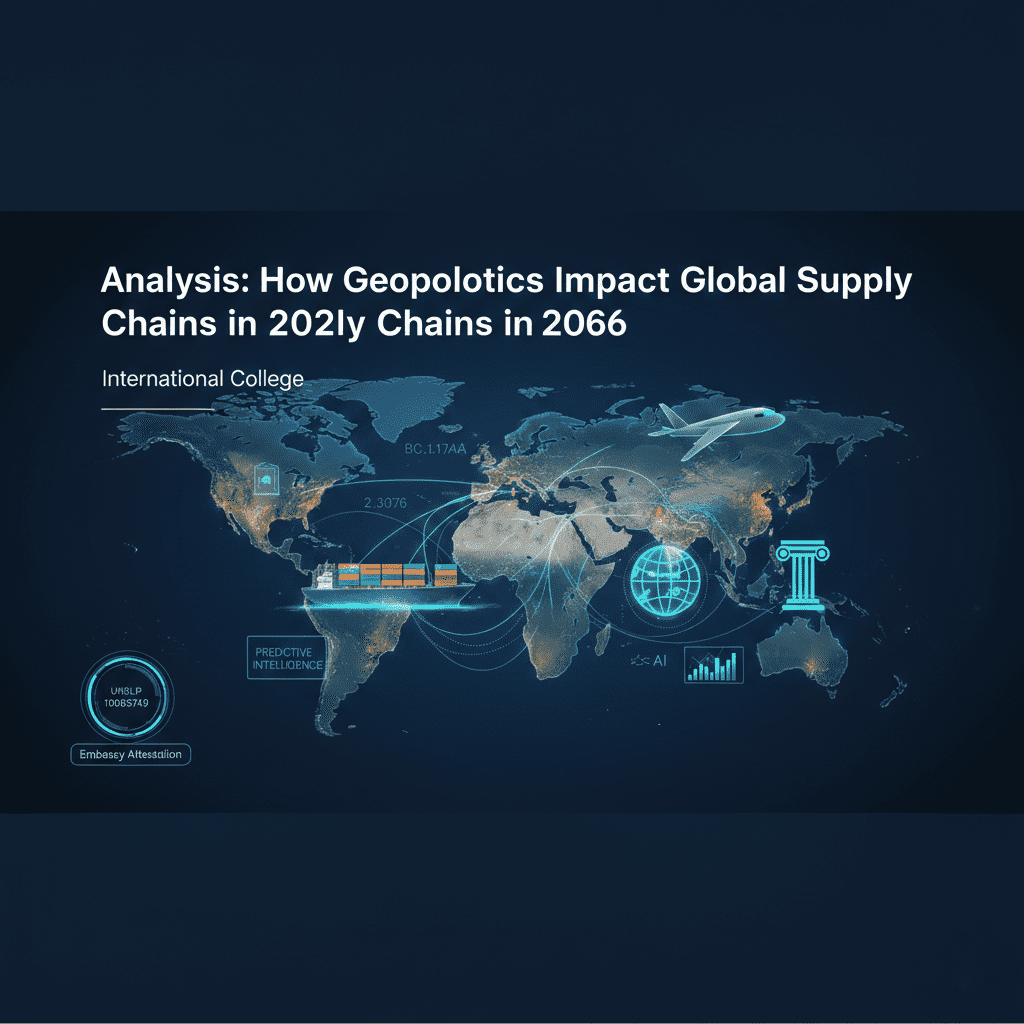
In the current global landscape, the "Trust Gap" is the greatest hurdle for ambitious professionals in the Middle East. You see the headlines—trade wars, route diversions, and shifting alliances—and you feel the pressure. Is your current expertise enough to navigate a crisis that didn’t exist six months ago? Or is the fear of career stagnation in an unpredictable market holding you back?
At International College, we bridge the gap between global ambition and recognized authority. We don't just provide information; we offer a UK-accredited gateway (UKRLP: 10065749) that transforms you from a logistics manager into a strategic geopolitical leader, backed by full Embassy Attestation and local recognition in KSA and the UAE.
Supply chain management is no longer a "back-office" logistical task; it is the front line of corporate strategy. In 2026, the intersection of Geopolitics and Supply Chain Management has become the primary driver of ROI for multinational firms operating in the GCC.
The era of hyper-globalization has been replaced by "Fragmented Trade." Companies are moving away from the "lowest cost" model toward Supply Chain Resilience. Whether it is the expansion of the IMEC corridor or the localization of manufacturing under Saudi Vision 2030, professionals must understand how regional stability directly dictates port efficiency and customs fluidity.
Risk management in 2026 isn't just about insurance—it's about Predictive Intelligence. With the integration of AI and Big Data, managing cross-border risks now requires a deep understanding of:
Sanction Compliance: Navigating the complex web of international trade restrictions.
Cyber-Geopolitics: Protecting physical supply lines from digital disruptions.
Strategic Sourcing: Balancing "Near-shoring" with "Friend-shoring" to ensure uninterrupted flow.
In a market saturated with unverified certifications, "Topical Authority" is your only currency. Leading a global supply chain requires more than experience; it requires a credential that speaks the language of international boardrooms.
UKRLP Registered Excellence: Our registration (10065749) ensures you are learning from a verified UK provider.
Embassy & MOFA Attestation: We solve the "Recognition Fear" by providing full support for degree legalization, ensuring your qualification is respected by government entities and major corporations in Dubai, Riyadh, and Abu Dhabi.
Elite Networking: Our programs connect you with industry leaders who are currently reshaping the logistics landscape of the Middle East.
The complexities of 2026 demand a new breed of leader—one who can read a geopolitical map as fluently as a balance sheet. Your career growth shouldn't be a victim of global instability; it should be the solution to it.
Ready to secure your future in the global market?
International College of Economics and Political Science (ICEPS) is an online education provider focused on professional learning, executive development, and career advancement. Our programmes are delivered online.
internationalcollege-online