
Leadership and Innovation
Degrees

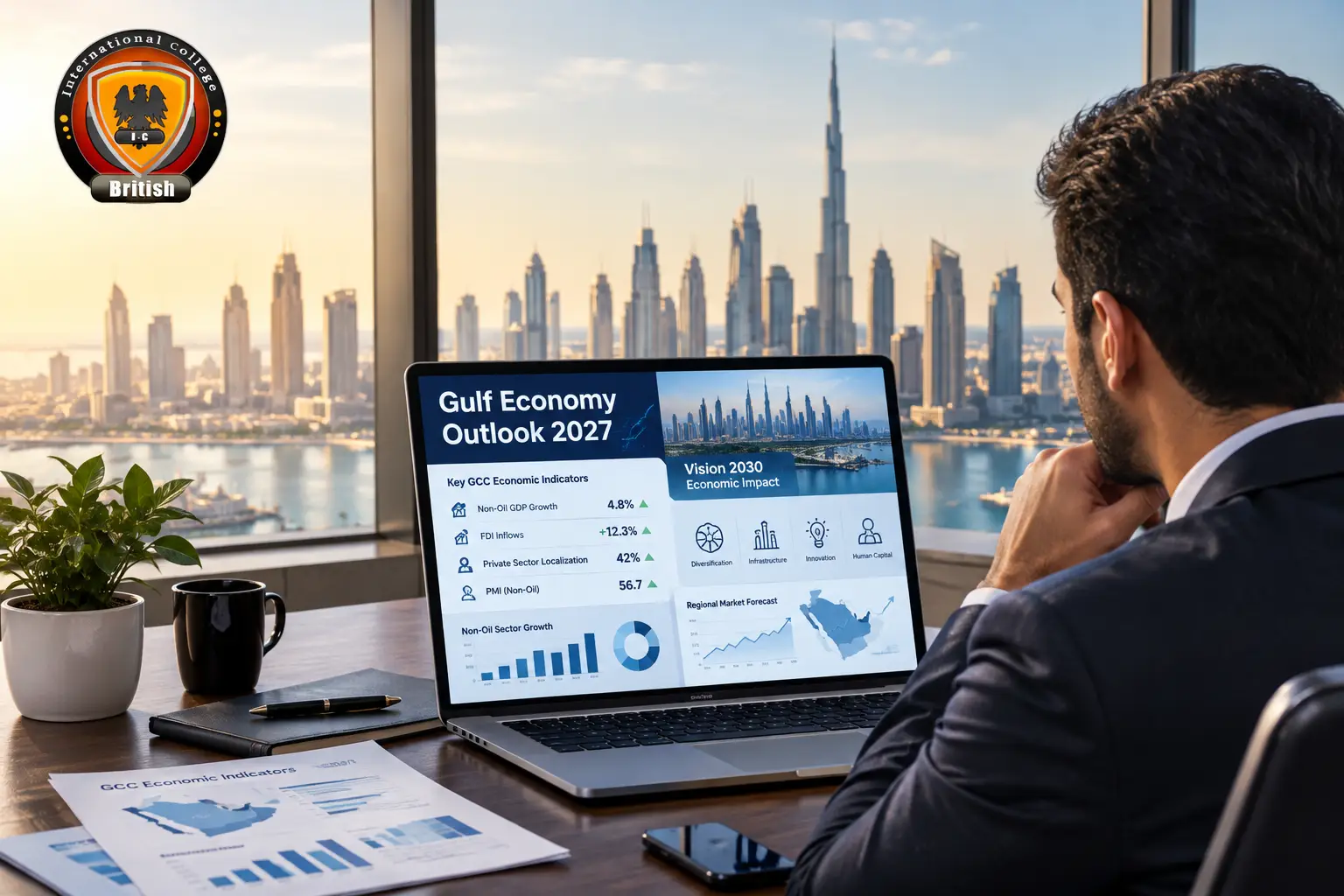
The Gulf economy outlook 2027 is defined by rapid non-oil sector expansion, structural fiscal reforms, and aggressive infrastructure investments. Regional executives must monitor specific GCC economic indicators—including non-hydrocarbon GDP, foreign direct investment (FDI) flows, and workforce localization rates—to accurately navigate the evolving regional market forecast. Tracking the Vision 2030 economic impact allows leadership teams to align corporate resource allocation directly with macro-level state priorities.
The macroeconomic baseline for the Gulf Cooperation Council (GCC) continues to shift from strict hydrocarbon reliance toward diversified, service-based, and industrial models. Corporate leaders must adjust their strategic planning horizons to account for state-led investments in technology, logistics, and private sector expansion. Understanding this economic environment requires moving beyond headline GDP to analyze the underlying data shaping capital flows and consumer behavior. Mastering these analytical frameworks establishes programme-aligned authority in economic education, particularly for working professionals in Egypt and the GCC.
Strategic decision-making relies on precise data interpretation. Managers should track these specific metrics to forecast operational risks and market opportunities effectively:
|
Indicator Category |
Specific Metric |
Strategic Implication for Managers |
|
Fiscal Policy |
Non-Oil Revenue Growth |
Signals government spending capacity on infrastructure and corporate contracts independently of global oil prices. |
|
Labor Dynamics |
Private Sector Localization |
Dictates human resources strategy, wage inflation, and long-term talent acquisition costs. |
|
Capital Flows |
Foreign Direct Investment (FDI) |
Indicates global market confidence and highlights specific sectors prioritized for regulatory easing. |
|
Corporate Health |
Purchasing Managers' Index (PMI) |
Provides a real-time snapshot of private-sector business conditions, inventory levels, and new order pipelines. |
National transformation initiatives act as the primary catalyst for market restructuring across the region. The Vision 2030 economic impact forces companies to recalibrate their operational models to maintain regulatory compliance, secure government tenders, and capture emerging consumer demand.
To remain competitive, executives must implement the following strategic adjustments:
Align Capital Expenditures with State Priorities: Direct corporate investments toward sectors subsidized by national strategies, such as renewable energy, domestic tourism, and digital infrastructure.
Optimize Supply Chain Resiliency: Localize procurement networks to meet tightening regulatory requirements and benefit from domestic industrial incentives.
Upgrade Human Capital: Invest heavily in continuous leadership development to address management skills gaps, as the demand for sophisticated operational leadership outpaces regional supply.
Translating a macroeconomic regional market forecast into a microeconomic corporate strategy requires a disciplined approach to risk management. Managers who actively monitor inflation indices, credit growth, and liquidity ratios can preemptively adjust pricing models and inventory logistics. Rigorous economic analysis separates reactive organizations from proactive market leaders, allowing executives to position their firms ahead of fiscal policy shifts.
Mastering these complex macroeconomic frameworks requires advanced, structured education designed for the realities of full-time employment. International College provides rigorous online/distance learning qualifications tailored specifically for working professionals in Egypt and the GCC. Equip yourself with the analytical tools required to lead in a transforming market. Explore our online management programmes and apply for the upcoming intake today.
It is considered one of the largest universities, as it has more than 65 accredited training programs. The student in the program obtains internationally accredited certificates and is certified by the study embassy What distinguishes our university from other universities in Britain is the large number of accreditations it enjoys, which makes it at the forefront of international universities that organize professional programs. It is a member of the UK Register of Centers for Education Providers (UKRLP) Search with registration number 10065749. It is also a member of the list of accredited non-governmental organizations of the Economic and Social Council of the United Nations, and also a registered member of the European Union's Transparency Register under the number TR-Q-2017-22003.

internationalcollege-online