
Leadership and Innovation
Degrees

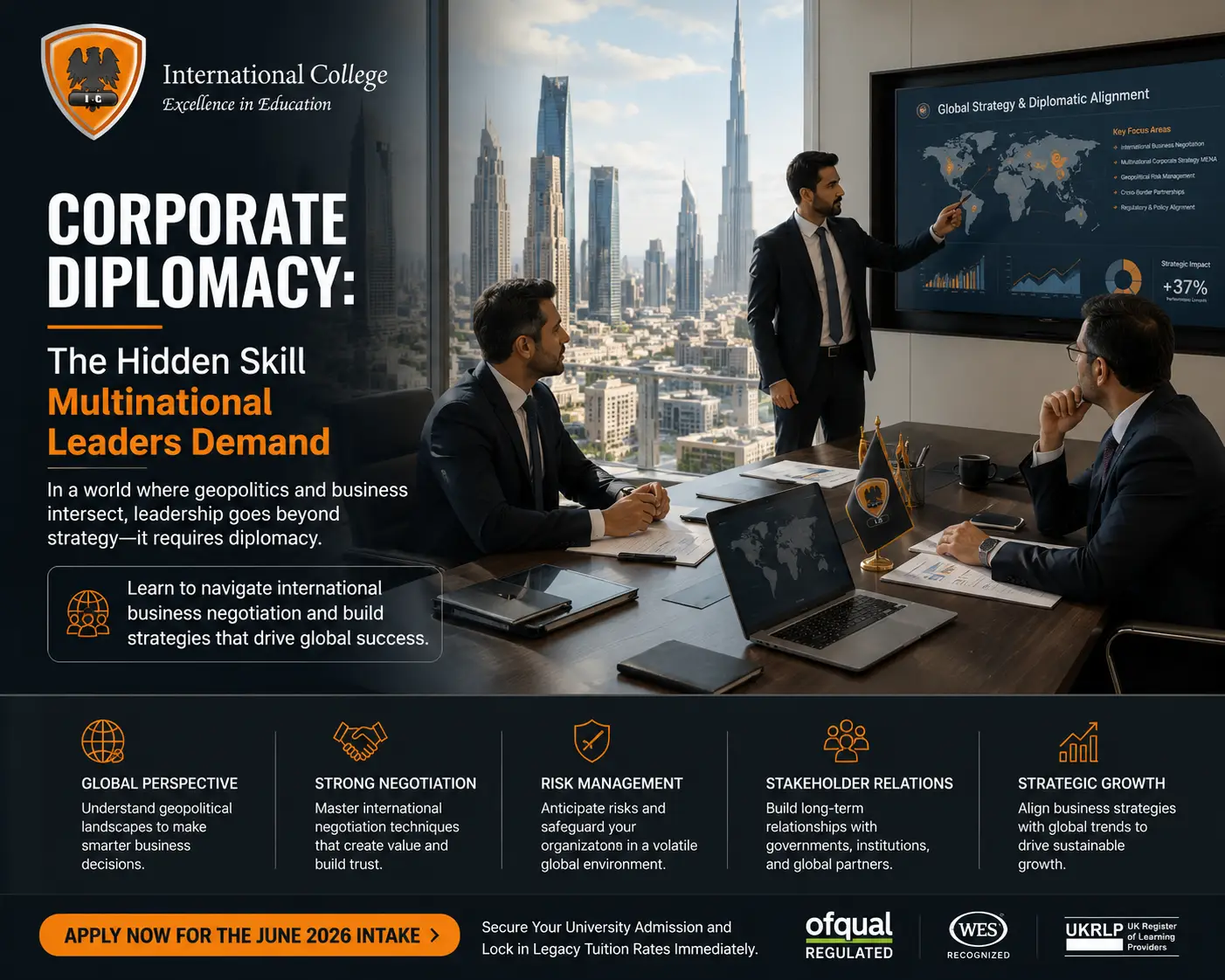
Modern global market integration requires cross-border corporate leaders who can manage geopolitical risk alongside commercial operations. Investing in a premium corporate diplomacy course provides executives with the strategic capabilities needed to manage complex international business negotiation frameworks. By aligning international relations theory with practical multinational corporate strategy MENA, leaders can successfully bridge regional regulatory gaps, secure foreign direct investments, and shield long-term corporate assets from shifting cross-border dynamics.
The baseline criteria for elite executive performance across the GCC have fundamentally mutated. In a regional ecosystem shaped by rapid state-backed expansions—such as Saudi Vision 2030 and the Dubai Economic Agenda D33—the separation between private enterprise and national geopolitical agendas has effectively vanished. Senior executives no longer operate within simple, isolated market variables; they manage multi-layered regulatory spaces, complex localized content policies, and fluctuating diplomatic environments.
To survive this operational shift, the modern C-suite demands deep capability in a historically overlooked discipline: corporate diplomacy. True executive authority requires moving past standard organizational administration to master the macro-level political forces shaping contemporary commerce.
Managing an enterprise within the Middle East, North Africa, and broader cross-border trade corridors requires a sophisticated understanding of macro-regional alignment. As nations within the GCC forge new global partnerships and restructure regional trade frameworks, old corporate risk assessment strategies fail.
A modern multinational corporate strategy MENA configuration must view government entities not merely as external regulatory barriers, but as primary institutional stakeholders. Leaders who fail to integrate foreign policy variables into their quarterly planning expose their enterprises to abrupt compliance friction, supply chain blockages, and capital stagnation.
The Traditional Approach: Insular market analysis focusing entirely on localized competitor pricing, standard product positioning, and immediate logistics pipelines.
The Diplomatic Approach: Deconstructing cross-border diplomatic alignments, tracking regional localization mandates (such as Saudization quotas), and anticipating state-driven economic pivots before they manifest as binding law.
The Asset Protection Shield: Cultivating institutional trust with ministries, sovereign wealth funds, and regional regulatory bodies to secure an enduring license to operate.
Executing high-value transactions within foreign investment zones demands a highly refined negotiation methodology that goes far beyond standard commercial contracting. When enterprise investments scale into multi-million-dollar infrastructure, logistics, or technology assets, negotiations transition from simple legal agreements to complex exercises in cross-cultural diplomacy.
Developing deep expertise in international business negotiation ensures that executives can build resilient international joint ventures, manage sensitive public-private partnerships (PPPs), and defuse corporate conflicts before they reach international arbitration courts.
Stakeholder Mapping: Identifying both visible commercial actors and underlying institutional, public, and regulatory power structures.
Value Alignment: Crafting corporate proposals so they actively advance the host nation’s strategic long-term development targets (e.g., local knowledge transfer and tech sector job creation).
Regulatory Anticipation: Building adaptable operational clauses into contracts to shield complex multi-year infrastructure investments against unexpected shifts in cross-border trade policies.
Relying on out-of-date executive education frameworks leaves an aspiring leader completely unequipped for the modern realities of global corporate governance. Short corporate training modules or unaccredited professional certificates often lack the deep structural and analytical rigor provided by a formal, university-backed program.
Completing a rigorous corporate diplomacy course provides the verified academic foundation required to manage high-stakes international business challenges.
|
Executive Capability |
Standard Management Program |
Accredited Corporate Diplomacy Integration |
|
Risk Management |
Insular financial and local operational tracking. |
Geopolitical macro-forecasting and state-level policy risk mitigation. |
|
Stakeholder Relations |
Limited to immediate B2B clients and shareholding circles. |
High-level engagement across sovereign wealth entities, ministries, and global regulatory bodies. |
|
Credential Parity |
Unverified or unaccredited certifications prone to local compliance rejection. |
Ofqual-regulated, WES-recognized academic pedigree built for global mobility. |
|
Career Trajectory |
Restricted to execution-level business management roles. |
Positioned for elite multinational directorships, Chief Strategy Officer, and COO roles. |
At International College, our advanced tracks resolve the modern "Trust Gap". By anchoring your geopolitical literacy within an Ofqual-regulated, UK-accredited degree registered on the UKRLP, your qualifications easily withstand intense corporate verification and WES validation—transforming your specialized strategic expertise into globally recognized executive capital.
The automated, highly integrated global era leaves zero room for credential ambiguity or stagnant, insular management skill sets. Protect your career trajectory, satisfy international executive recruitment standards, and position your profile at the absolute apex of global corporate governance.
[Apply Now for the June 2026 Intake — Secure Your University Admission and Lock in Legacy Tuition Rates Immediately]
International College of Economics and Political Science (ICEPS) is an online education provider focused on professional learning, executive development, and career advancement. Our programmes are delivered online.
internationalcollege-online