
Leadership and Innovation
Degrees

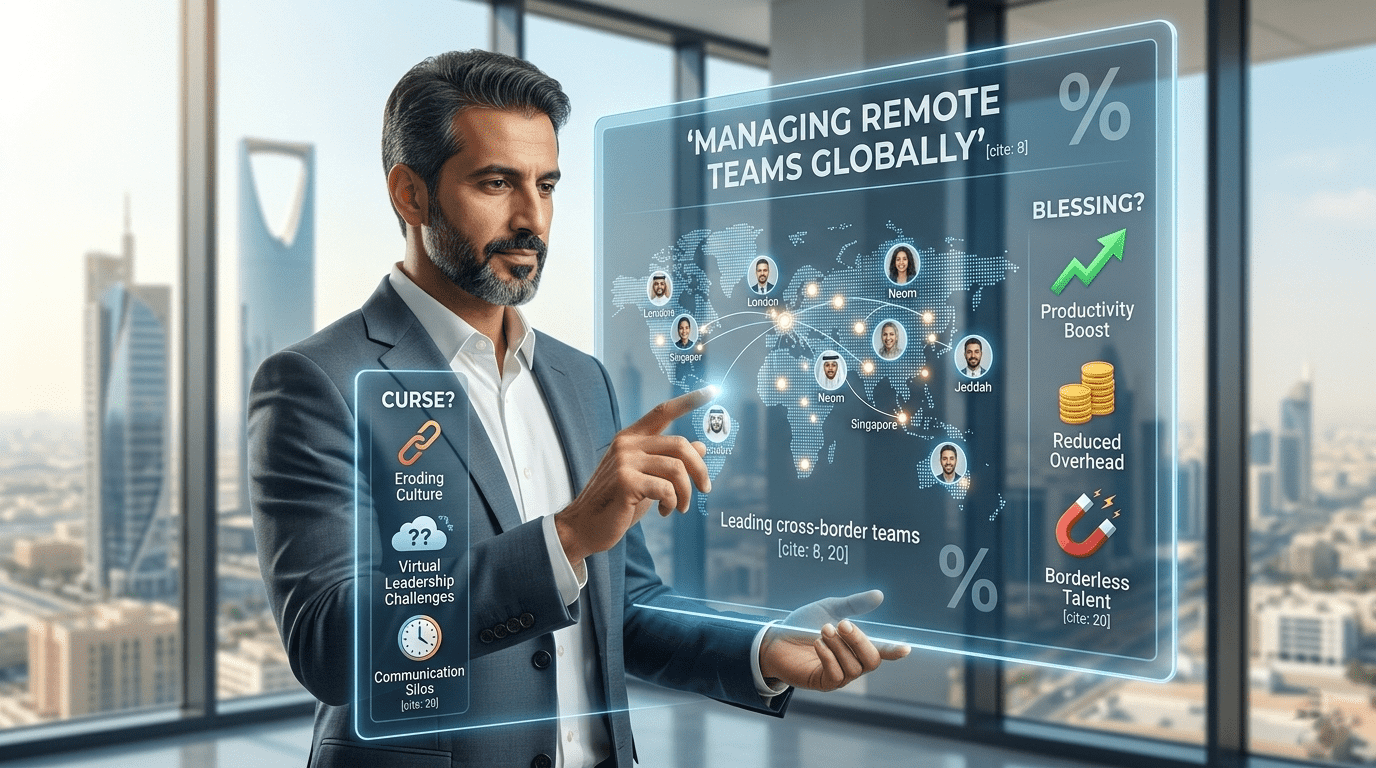
The "Deep Fear" for many senior managers in Riyadh and Dubai today is a silent one: the fear of losing control. In the era of Saudi Vision 2030 and Dubai 2033, the transition to decentralized operations has left many leaders feeling like they are managing "ghosts" rather than teams. You worry that without the physical presence of your staff, productivity is a facade, culture is eroding, and your own leadership relevance is slipping away. Or perhaps, you fear the opposite—that by insisting on a traditional office, you are losing your best talent to global competitors who offer the flexibility you deny.
At International College, we recognize that this tension is where modern leadership is born. We serve as the bridge between your traditional management background and the high-level recognized UK education required to navigate the complexities of the modern workplace. Mastering the art of Managing Remote Teams Globally is no longer an optional skill; it is the benchmark of a contemporary executive.
Is remote work the ultimate tool for global scaling, or is it a slow poison for corporate cohesion? As global firms expand, the answer depends entirely on the framework of leadership applied.
For firms in the UAE and KSA, remote work has opened the floodgates to global expertise. Leading cross-border teams allows a company in Neom to collaborate with developers in London or data scientists in Singapore in real-time.
Reduced Overhead: Massive savings on physical infrastructure.
Talent Retention: Top-tier professionals now prioritize flexibility over high-rise offices.
24/7 Productivity: Utilizing time zone differences to ensure projects never sleep.
Conversely, many CEOs argue that remote work creates silos. Virtual leadership challenges often include the loss of "watercooler innovation" and the difficulty of maintaining a unified corporate identity across different cultures and time zones.
The transition to Hybrid work models UAE and KSA firms are adopting requires more than just a Zoom subscription; it requires a pedagogical shift in management. To lead effectively from a distance, managers must master three core pillars:
Result-Oriented Monitoring: Shifting from "hours at the desk" to "value delivered."
Cultural Intelligence (CQ): Understanding the nuances of communication when leading cross-border teams.
Digital Synchronicity: Using AI and project management tools to create a "digital twin" of the office environment.
In a world where you may never meet your employer in person, the "Trust Gap" is wider than ever. How do you prove your authority to manage a multi-million dollar global operation from a home office in Jeddah?
This is where the rigor of International College and our UK-accredited programs provide your "Institutional Shield." We ensure your expertise is beyond reproach through:
UKRLP Registration (10065749): Providing public, verifiable proof that your education comes from a legitimate UK provider.
Embassy Attestation: We facilitate the Embassy Attestation process, ensuring your degree is recognized by the British Embassy and local Ministries of Foreign Affairs (MOFA). This is critical for professionals seeking to upgrade their titles or secure remote-work visas.
Local Recognition Capabilities: We tailor our support to ensure your UK qualification meets the specific equivalency standards of the GCC, allowing you to lead with total confidence.
As we move toward 2026, the "all or nothing" approach to remote work is fading. The winners are those implementing sophisticated Hybrid work models UAE style—combining the deep focus of remote work with the strategic alignment of monthly in-person intensives.
Managing Remote Teams Globally requires a specific set of digital transformation skills. It requires a leader who understands that "presence" is a psychological state, not a geographical one.
So, we ask you—the leaders on the front lines: Is remote work a blessing that scales talent, or a curse that kills culture? In your experience in the Middle East market, have you found that productivity rises or falls when the office doors close?
The future of work is being written right now. Don't be a manager who watches it happen—be the leader who directs it.
[Check Your Eligibility for a UK Management Degree]
International College of Economics and Political Science (ICEPS) is an online education provider focused on professional learning, executive development, and career advancement. Our programmes are delivered online.
internationalcollege-online